

Updated on 6 October 2026 · Reviewed by the FiscalControl technical team, a HACCP-certified consultancy in the Algarve.
Direct answer: Yes. Food traceability is a legal obligation: the law requires every food business operator to be able to identify, at any time, who supplied them with a given product and to whom they passed it on next — the “one step back, one step forward” principle set out in Article 18 of Regulation (EC) No 178/2002. In practice, this means that, faced with a specific dish or ingredient, you must be able to reconstruct the complete journey within minutes: supplier, batch, date of receipt, storage conditions and use. If you can’t do this exercise right now, for any product in your kitchen, your establishment’s traceability has a real gap.
Take the Test Now
Before you keep reading, pick a product at random from your kitchen — a bag of frozen shrimp, a bottle of olive oil, a cheese. Then try to answer, without searching for more than five minutes: who supplied this product? What was the batch? When was it received? Where is the corresponding invoice or delivery note? This simple exercise shows, in seconds, whether your restaurant’s food traceability is actually in place.
If you answered the four questions quickly, your traceability system is working. If you had to search in several places, or couldn’t find the answer at all, that is exactly the gap that an ASAE inspection — or, worse, a product recall alert — will expose.
What the Law Requires: “One Step Back, One Step Forward”
Article 18 of Regulation (EC) No 178/2002 requires the traceability of food, feed and food-producing animals to be established at all stages of production, processing and distribution. In practice, this translates into the “one step back, one step forward” principle: every operator must be able to identify, at a minimum, who supplied them with a product and to whom they supplied it next.
For a restaurant, this means always knowing who supplied each ingredient that enters the kitchen — the “step forward” is usually the customer who eats the dish, which is why the critical part of the chain for a restaurant business is mainly the “step back”.
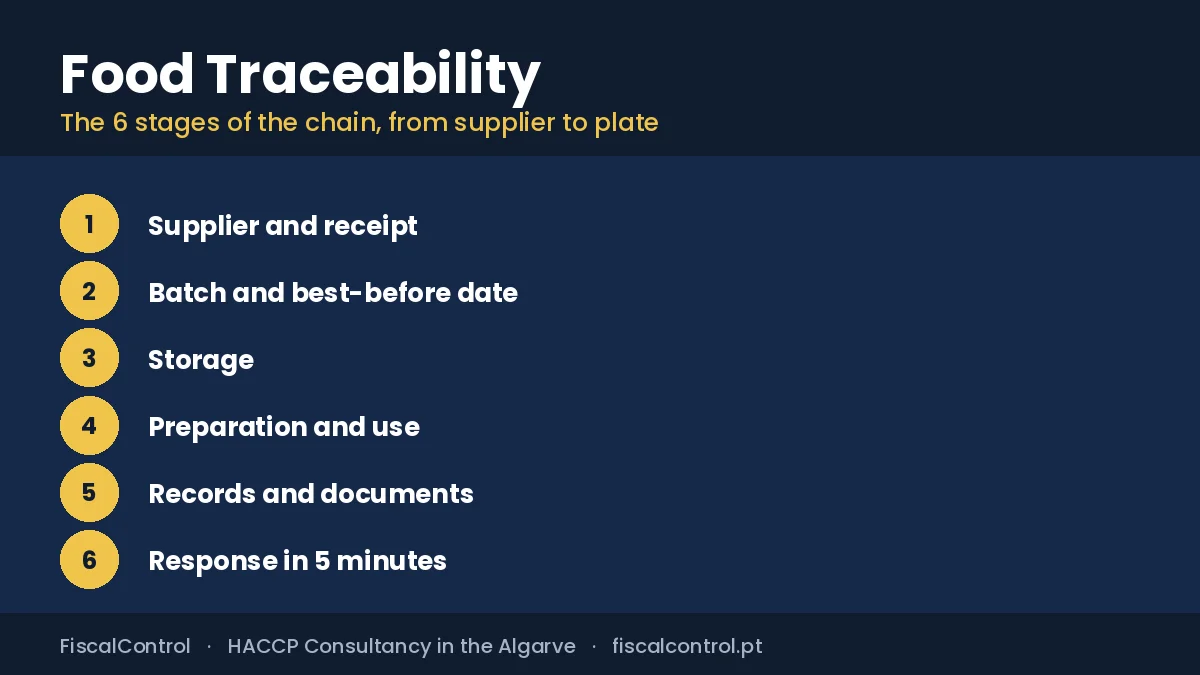
The Six Stages of the Food Traceability Chain
To be able to reconstruct a product’s journey within minutes, each of these stages needs to be documented:
- Receipt — date and time the product entered the establishment
- Supplier — clear identification of who supplied the product (invoice or delivery note)
- Batch — the product’s batch number, whenever applicable (mandatory for pre-packaged products, recommended for fresh products whenever the supplier provides it)
- Storage — where and under what conditions the product was kept until it was used
- Use — which dishes or preparations the product was actually used in, and on which dates
- Withdrawal — if it becomes necessary to withdraw the product from use (due to a supplier alert or your own decision), the ability to quickly identify all dishes or customers potentially affected
Most establishments have stages 1 and 2 reasonably organised (they keep invoices), but fall short on stages 3, 5 and 6 — they don’t link the specific batch to the specific dish it was used in.
Documents That Support Each Stage
In practice, traceability doesn’t require a complex system — it requires that the documents you already have (invoices, delivery notes) are organised in a searchable way, and that a simple record links each high-risk raw material to the dish where it was used, especially for products such as fish, shellfish, meat and dairy.
A simple internal traceability system can be as basic as a daily log sheet: product, supplier, batch (if applicable), date of receipt, and a note of which preparations it was used in that day.
What to Do in the Case of a Recall Alert
Article 19 of Regulation (EC) No 178/2002 requires the operator to immediately inform the competent authority whenever it has reason to believe that a product placed on the market is not safe, and to proceed with its withdrawal or recall. If your supplier notifies you of a recall alert — which happens fairly regularly with products such as shellfish, eggs or dairy — how quickly you can identify whether you received that batch, and which dishes it was used in, directly determines your ability to respond and protect your customers.
This is also why the new Listeria monocytogenes rules, in force since 1 July 2026, make traceability even more critical: when faced with a positive result, it is the link between batch and dish that allows you to act in time.
Most Common Traceability Mistakes in Restaurants
- Keeping invoices without organising them by product or by date, which makes searching slow whenever it’s needed
- Not recording the batch number of fresh products, even when the supplier provides it on the invoice
- Not linking the product to the dish — knowing you bought fish is different from knowing in which dishes, and on which days, that specific fish was served
- Relying solely on staff memory instead of a written record, especially in kitchens with staff turnover
In Summary
Food traceability isn’t a bureaucratic exercise — it’s the real ability to answer, within minutes, the question “where did this product come from and where did it go?” for any dish on your menu. Most establishments have part of the chain organised, but fail at the point that matters most in an inspection or a recall: linking supplier, batch and dish. Setting up a simple daily record, even a basic one, closes that gap and protects both your customers and your business.
Frequently Asked Questions
Am I required to record the batch number of every product I buy? For pre-packaged products, the batch is usually indicated by the supplier and should be recorded whenever available. For fresh products with no formal batch, you should be able to identify at least the supplier and the date of receipt.
How long should I keep traceability records? There is no single legal deadline that applies to every case, but recommended practice is to keep records for at least the product’s shelf life plus a reasonable period in which a consumer could identify a problem — in practice, many HACCP plans set a minimum of six months to a year.
What do I do if I receive a recall alert from a supplier? You should immediately check whether you received the batch in question, remove the product from use if you still have it, and identify whether and when it was served to customers. If necessary, inform ASAE under Article 19 of Regulation (EC) No 178/2002.
Does traceability only apply to animal-origin products? No. The “one step back, one step forward” principle applies to all foodstuffs, although higher-risk products (meat, fish, shellfish, eggs, dairy) usually deserve closer control.
Test Your Establishment’s Traceability Before ASAE Does
If you couldn’t answer the quick test at the start of this article, that’s a good sign it’s worth reviewing your system now — before an inspection does it for you.
⚠️ Not being able to reconstruct a product’s origin within minutes is one of the most heavily penalised failures in an ASAE inspection.
With FiscalControl, you get:
✅ An audit of your current traceability system ✅ Simple record templates, adapted to your operation ✅ A clear link between suppliers, batches and dishes served ✅ Direct support in the event of an inspection or recall alert
No commitment. No small print. Just peace of mind.
We support restaurants and hotels across the country, with a strong presence in the Algarve — Faro, Portimão, Albufeira, Lagos, Loulé, Tavira and Vilamoura.
FiscalControl | R. Primeiro de Junho 9 2º C, 8150-111 São Brás de Alportel
Leave a Reply