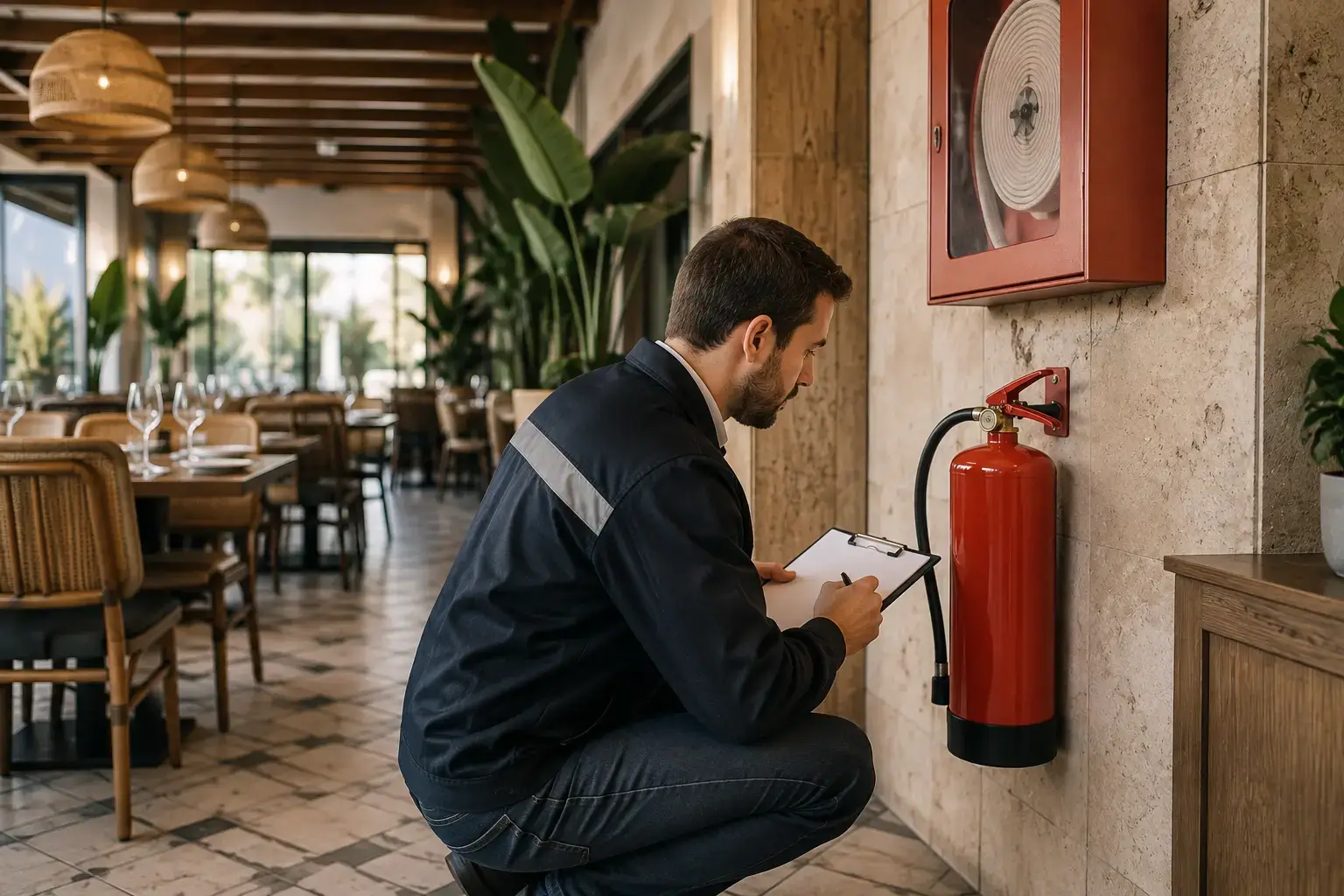
The Algarve is the region of Portugal with the highest concentration of food and beverage establishments per square kilometre — especially in Albufeira, Vilamoura (Loulé) and Faro. A packed terrace, an industrial kitchen running at full capacity and an old building in Faro’s historic centre add up to an equation that demands serious fire safety measures.
Self-Protection Measures (Medidas de Autoproteção, or MAP) are the set of procedures and safety resources every establishment must have in place to respond to emergency situations — with a particular focus on fire. They are mandatory for the vast majority of restaurants in the Algarve.
The legal framework setting out these obligations is Decreto-Lei n.º 220/2008, de 12 de novembro (the Legal Regime for Fire Safety in Buildings — SCIE) and Portaria n.º 1532/2008, de 29 de dezembro (the SCIE Technical Regulation).
What Are Self-Protection Measures (MAP)?
The MAP for a restaurant in Faro, Albufeira or Loulé include:
- Prevention Plan — organisation and procedures to reduce day-to-day fire risk
- Emergency Plan — what to do when an emergency occurs: who does what, how to evacuate, how to trigger the alarm
- Safety Records — documentation of inspections, maintenance and drills carried out
- Staff training and drills — does the team know how to respond? In Albufeira during summer, with international seasonal staff, this is a critical issue
- Evacuation drills — practical evacuation exercises carried out at intervals set by law
Which Algarve Restaurants Are Required to Have MAP?
Restaurants and similar establishments fall under Use Type VIII (Food and beverage service). The Risk Category determines the level of MAP requirements:
| Category | Main criteria | Examples in the Algarve |
|---|---|---|
| 1st (lowest) | Up to 1 floor, capacity ≤ 100 seats | Tasca in Loulé, café in Faro |
| 2nd | Up to 3 floors, capacity up to 500 seats | Mid-size restaurant in Albufeira |
| 3rd | Up to 9 floors, capacity up to 1,500 seats | Hotel restaurant in Vilamoura |
| 4th (highest) | More than 9 floors, or > 1,500 seats | Large tourist resort complexes |
Practical rule for the Algarve: The vast majority of restaurants in Faro, Albufeira and Loulé fall under the 1st or 2nd Risk Category and are required to have, at minimum, Safety Records and a Prevention Plan.
The Algarve’s Specific Context: Why MAP Matter Even More Here
Specific characteristics of the Algarve market make MAP especially important:
Old buildings in the historic centres of Faro and Loulé — many restaurants operate in 18th- or 19th-century buildings, with outdated electrical infrastructure and construction materials more vulnerable to fire.
High occupancy density in Albufeira — especially in July and August, when a restaurant can run at full capacity for hours at a time, including customers unfamiliar with the space.
International seasonal teams — staff from different countries who don’t know where the emergency exits are, don’t speak Portuguese and have never taken part in a drill at that venue.
Terraces with gas heaters — very common in Algarve restaurants during the cold season, carrying specific fire and explosion risks.
Industrial kitchens with deep fryers and charcoal grills — Algarve restaurants serving grilled fish or charcoal-grilled chicken carry a specific fire risk that must be addressed in the MAP.
What Should Be Included in the MAP for a Restaurant in the Algarve
For most restaurants in Faro, Albufeira and Loulé (1st and 2nd Risk Categories), the MAP should include:
Safety Records (mandatory for all categories)
- Relevant occurrences (fires, alarms, malfunctions)
- Inspection and survey reports
- Maintenance of safety systems and equipment (fire extinguishers, emergency lighting)
- Reports on evacuation drills carried out
Prevention Plan (mandatory from the 1st category)
- Who is the establishment’s Safety Officer?
- Fire prevention procedures (daily check routines)
- Maintaining evacuation conditions (clear exits, visible signage)
Internal Emergency Plan (mandatory from the 3rd category)
For large restaurants and event venues in Vilamoura, Vale do Lobo or Quinta do Lago — all within Loulé — this plan is mandatory and includes an emergency structure organisation chart, emergency floor plans and detailed procedures.
Mandatory Safety Equipment in Algarve Restaurants
Beyond the MAP documentation, restaurants must have safety equipment suited to their category:
For all restaurants (including small ones in Faro, Albufeira and Loulé):
- Fire extinguishers in a number and type suited to the activity
- Emergency signage (exits, equipment)
- Emergency lighting
For higher categories:
- Fitted fire hose reels (hydrant network)
- Automatic fire detection system
- Smoke control system
Mandatory maintenance: All fire extinguishers and safety equipment must be inspected and maintained at the legally required intervals, with records filed in the Safety Records.
Consequences of Not Having MAP in Restaurants in Faro, Albufeira and Loulé
The consequences of non-compliance are serious:
Substantial fines — Decreto-Lei n.º 220/2008 provides for fines that, for businesses, can reach high amounts, increased in the case of repeat offences.
Formal notice and mandatory compliance — ANEPC and the Câmaras Municipais of Faro, Albufeira and Loulé have the authority to verify compliance and require works or changes.
Civil and criminal liability — in the event of a fire with casualties, the absence of MAP significantly increases the owner’s liability. At a restaurant full of tourists in Albufeira in August, the human and legal consequences could be catastrophic.
Insurance implications — liability insurance policies for restaurants often exclude or limit coverage when legal SCIE obligations have not been met.
When Do the MAP for an Algarve Restaurant Need Updating?
MAP are not a static document — they must be updated whenever relevant changes occur:
- Renovation or extension works (very common at Albufeira restaurants expanding onto terraces)
- Change in the establishment’s capacity
- Change of the business operator
- Installation or replacement of safety systems
- Appointment of a new Safety Officer
FAQ: Self-Protection Measures in Algarve Restaurants
My restaurant in Faro only has 25 seats. Do I really need MAP?
Yes. Even small establishments have fire safety obligations. For the 1st Risk Category, the requirements are lighter — but they still apply.
How often do I need to run drills at my restaurant in Albufeira?
For the 1st and 2nd categories: every two years. For the 3rd and 4th categories: annually. For restaurants with seasonal staff in Albufeira, it’s recommended to run the drill at the start of each high season.
Who can draw up the MAP for my restaurant in Loulé?
MAP must be drawn up by a Fire Safety in Buildings Technician (TSCIE) or an architect/engineer qualified in the field.
I have a new restaurant in Albufeira. Are MAP mandatory before opening?
Depending on the risk category, prior approval of the MAP by ANEPC or an inspection by the Câmara Municipal de Albufeira may be required before opening.
Do my seasonal workers have to take part in the drills?
Yes. Everyone present at the establishment must take part in the drills — including seasonal workers, who in summer make up most of the team at Albufeira restaurants.
Self-Protection Measures in the Algarve — Faro, Albufeira and Loulé with Fiscal Control
Fiscal Control draws up and updates Self-Protection Measures for HORECA establishments throughout the Algarve — in Faro, Albufeira, Loulé, Olhão, Portimão, Lagos, Tavira and neighbouring municipalities.
Our service includes reviewing the applicable legal framework, drawing up all the required documentation, training staff — including international seasonal teams — organising drills and providing support during inspections.
The safety of your customers and your team has no low season.
👉 Request a MAP proposal for your restaurant →
Decreto-Lei n.º 220/2008, de 12 de novembro; Portaria n.º 1532/2008, de 29 de dezembro.
Leave a Reply