Updated on 3 September 2026 · Reviewed by the FiscalControl technical team, a HACCP-certified consultancy in the Algarve.
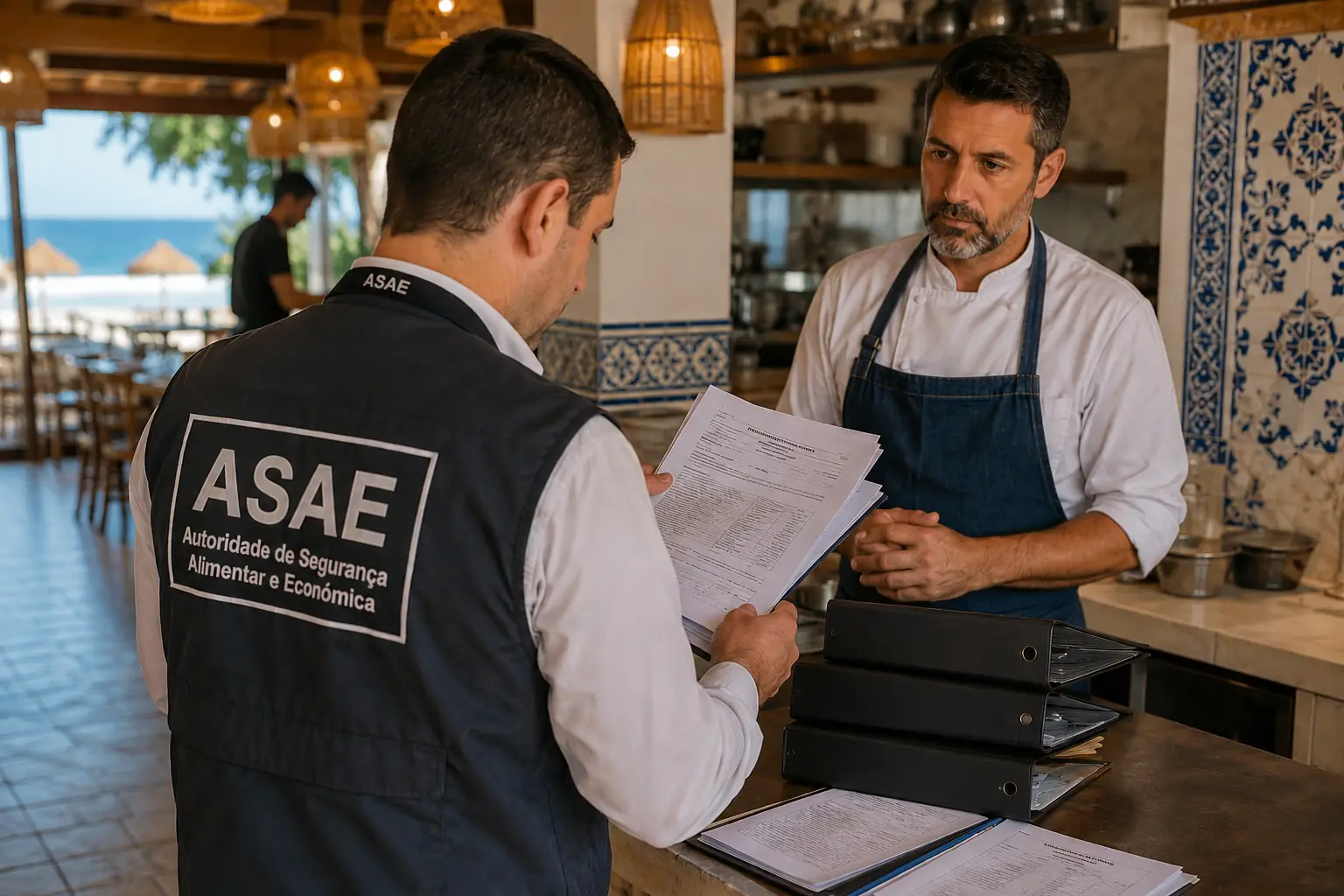
During an ASAE inspection, a restaurant must be able to produce ten documents within a few minutes: an up-to-date HACCP plan, temperature records, traceability records, a sanitation plan and records, a pest control contract and reports, proof of food handler training, technical data sheets for products and equipment, an allergen map, microbiological/water analyses (where applicable), and a record of corrective actions. The absence of any one of these can lead to a warning, a fine or, in serious cases, the immediate suspension of activity.
ASAE (the Food and Economic Safety Authority) does not give notice before entering. Inspectors arrive, identify themselves, and from that moment the clock starts running. In practice, the first five to ten minutes of an inspection carry the most weight in the final outcome: this is when the inspector assesses whether the establishment has its documentation organised and accessible.
This article works as an operational checklist. It isn’t a theoretical list of what “should exist” — it’s what a floor or kitchen manager should be able to have in hand, physically or digitally, without wasting time searching for it.
Let’s go straight to the ten points.
1. An Up-to-Date HACCP Plan
The HACCP system (Hazard Analysis and Critical Control Points), required under Regulamento (CE) n.º 852/2004, is the base document of any inspection. It isn’t enough for it to exist: it must be up to date with the establishment’s current reality — menu, suppliers, layout and equipment in use. An outdated plan (for example, one that still lists dishes no longer on the menu, or that omits a new piece of equipment) is one of the most common mistakes found during inspections.
2. Temperature Control Records
Fridges, freezers, display cases and, where applicable, transport. ASAE wants to see consistency — daily records, without gaps — not just “nice-looking” numbers. Isolated deviations aren’t the problem; the absence of a recorded corrective action is.
3. Traceability Records
The ability to link a product on a dish to its supplier and batch of origin. This includes invoices or delivery notes organised in a way that, given a specific product, its journey can be reconstructed within a few minutes.
4. Sanitation Plan and Records
Cleaning and disinfection procedures for surfaces, equipment and utensils, with a defined frequency and execution records — not just the plan on paper, but proof that it is being followed.
5. Pest Control Contract and Records
An active contract with a certified company, a bait station map and up-to-date visit reports. A contract that exists “on paper” without recent monitoring reports is treated as non-compliance.
6. Proof of Food Safety Training
All food handlers must have valid, documented training, under Decreto-Lei n.º 10/2015. Missing training certificates for any staff member currently in post is one of the most frequent reasons for an official report to be drawn up.
7. Technical Data Sheets for Products and Equipment
Technical data sheets for raw materials (especially higher-risk products: dairy, egg products, fish) and for refrigeration equipment, showing capacities and reference temperatures.
8. Allergen Map and Labelling
An up-to-date list of the 14 allergens that must be declared, by dish, available for immediate consultation by both the customer and the inspector. The menu or a supporting document must accurately reflect the actual composition of the dishes served.
9. Microbiological and Water Analyses
Where applicable — water analyses (when the supply is not directly from the public network) and microbiological analyses of products or surfaces, in line with the establishment’s self-monitoring plan.
10. Record of Corrective Actions
The document most often forgotten. It isn’t enough to identify a deviation (a temperature outside the limit, a sanitation non-conformity); you need to show that a corrective action was taken and recorded. This is the record that shows the inspector the HACCP system is “alive” and not just paperwork sitting in a file.
In Summary
The ten documents an ASAE inspection typically checks at a restaurant are: the HACCP plan, temperature records, traceability records, sanitation plan, pest control contract, proof of training, technical data sheets, allergen map, microbiological/water analyses, and record of corrective actions. Keeping these ten points organised and accessible is the single factor that most reduces the risk of a fine or suspension of activity. Check the official ASAE website for up-to-date guidance on the inspection process.
Frequently Asked Questions
Does ASAE give notice before an inspection? No. ASAE inspections are, as a rule, unannounced. The establishment must be prepared to present its documentation at any time during operating hours.
What happens if one of these documents is missing? It depends on the severity and on repeat occurrences: it can result in a warning, an official report with a fine, or, in serious cases posing a risk to public health, the immediate suspension of activity.
Is it acceptable to keep the documents in digital format? Yes, provided they are immediately accessible on-site during the inspection. Well-organised digital records (with photographs, timestamps and history) are often more efficient than paper folders.
How often should the HACCP plan be reviewed? Whenever there is a change of supplier, ingredient, recipe, equipment or layout — and at least once a year, even with no apparent changes.
Preparing Your Establishment for an ASAE Inspection
Keeping these ten points organised isn’t just about complying with the law — it’s what separates a calm inspection from one that ends in a fine or suspension. Document organisation is, in practice, the most controllable factor in the entire inspection process.
⚠️ Fines of up to €15,000. Suspension of activity. A destroyed reputation.
That’s what’s at stake when one of these ten documents is missing the moment the inspector walks through the door. The good news is that it’s prevented with organisation — not luck.
With FiscalControl, you get:
✅ A HACCP plan adapted to your kitchen ✅ Documentation always ready to present ✅ Regular technical visits ✅ Direct support in the event of an inspection
We support restaurants and hotels across the Algarve — Faro, Portimão, Albufeira, Lagos, Loulé, Tavira and Vilamoura.
FiscalControl | R. Primeiro de Junho 9 2º C, 8150-111 São Brás de Alportel
Leave a Reply