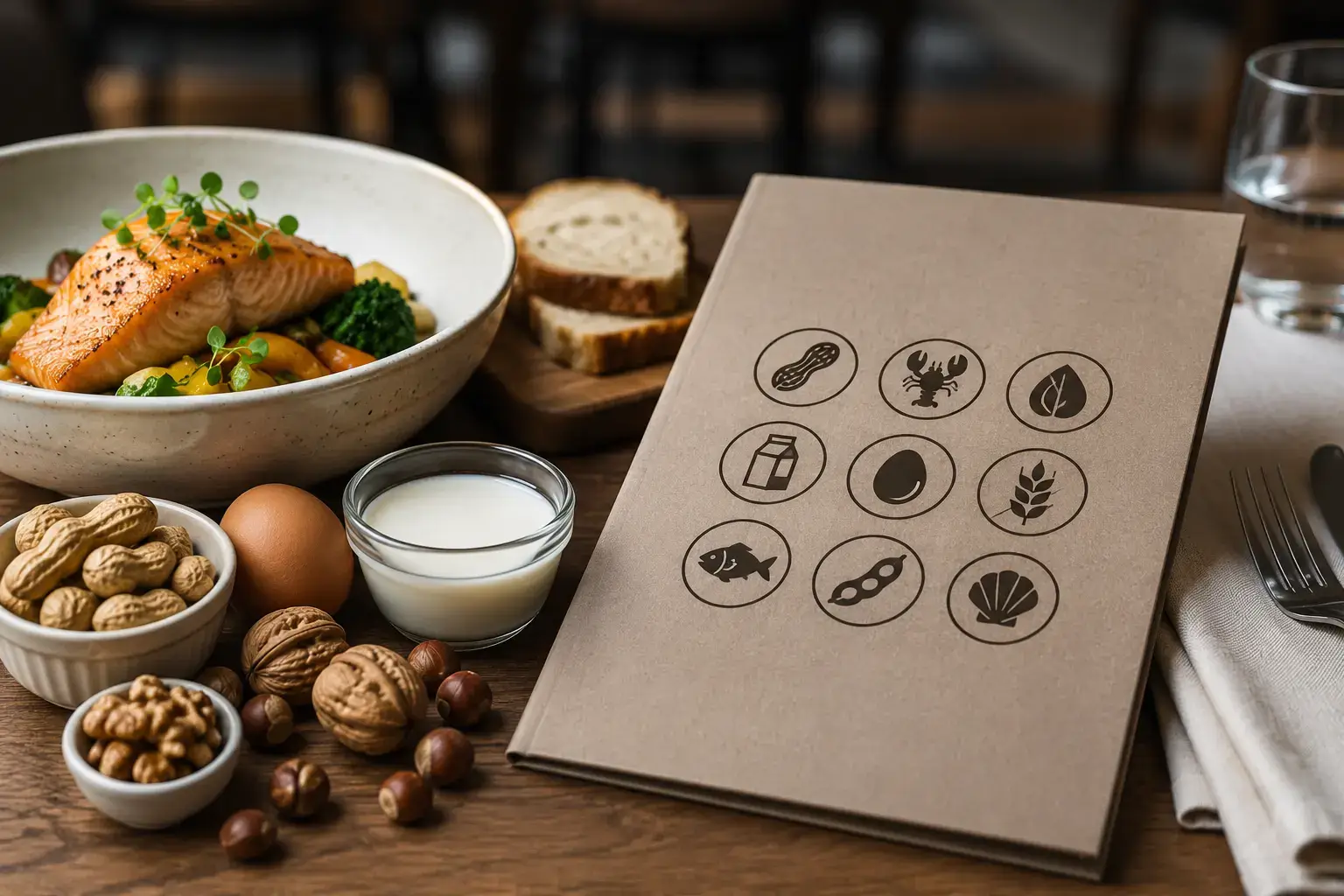
In a tourist destination like the Algarve — where restaurants in Albufeira, Loulé and Faro welcome guests from dozens of countries, with very diverse dietary habits and medical conditions — allergen information on the menu is not just a legal formality. It is a matter of life safety.
An anaphylactic reaction to tree nuts or shellfish can be fatal within minutes. And an operator who has not provided the correct information is civilly — and potentially criminally — liable.
The good news: the law does not require allergens to appear on the printed menu itself. The operator can choose other ways of making the information available — but it must always exist, in an accessible and clear form.
The 14 Allergens That Must Be Declared
Regulamento (UE) n.º 1169/2011 sets out 14 substances that cause allergies or intolerances and that must always be declared at any food service establishment — from a snack bar in central Loulé to a fine-dining restaurant in Vale do Lobo:
- Cereals containing gluten (wheat, rye, barley, oats, spelt, kamut)
- Crustaceans and crustacean products
- Eggs and egg products
- Fish and fish products
- Peanuts and peanut products
- Soybeans and soy products
- Milk and milk products (including lactose)
- Tree nuts (almonds, hazelnuts, walnuts, cashews, pecans, Brazil nuts, pistachios, macadamia nuts)
- Celery and celery products
- Mustard and mustard products
- Sesame seeds and sesame seed products
- Sulphur dioxide and sulphites at concentrations above 10 mg/kg or 10 mg/litre
- Lupin and lupin products
- Molluscs and mollusc products
On the menu or whichever information medium is used, these allergens must be clearly highlighted — in bold, underlined, or in a colour that differs from the rest of the text.
How to Present the Information: Allergens on the Menu – Legal Options for Restaurants in Faro, Albufeira and Loulé
There are several legally valid ways to make allergen information available:
Option 1 — On the printed menu (most common, most recommended)
Next to each dish or in a dedicated section, with the allergens present highlighted by symbol, bold text or colour.
Option 2 — A separate, visible medium
A wall panel, a board near the entrance, a folder available for consultation at the tables. It must be easily accessible to any customer without needing to ask staff.
Option 3 — Verbal information, backed by a written record
Staff can communicate allergens verbally, but a written document must always exist with the complete information, available for immediate consultation — including by ASAE inspectors.
For restaurants in Albufeira or Faro that mainly serve foreign tourists, it is strongly recommended that the information be available at least in English and Portuguese — and ideally also in German, Dutch and French, the languages of the main source markets for the Algarve.
Product Shelf Life: The Distinction That Can Prevent Serious Fines
This point is directly linked to consumer safety and is systematically checked by ASAE in Faro, Albufeira and Loulé:
Use-By Date — “Use by…”
Applies to highly perishable products: fresh meat, fresh fish, packaged deli meats. After this date, sale is prohibited — regardless of the product’s visual appearance.
Best-Before Date — “Best before…”
Applies to less perishable products: pasta, rice, canned goods, flour, sugar, olive oil, other oils. After this date, the product may still be sold, provided the consumer is informed and the operator guarantees the product retains its safety and properties.
Having products with an expired use-by date in storage is one of the infractions most frequently detected by ASAE during summer inspections in the Algarve — a period when stock turns over faster, but operational pressure can lower attention to checking shelf life.
Olive Oil, Vinegar, Wine and Water: Obligations Often Forgotten by Algarve Restaurants
Olive oil in cruets — a tamper-proof obligation
Olive oil provided as a table condiment must be packaged in tamper-proof containers with an opening system that loses its integrity after first use. These containers cannot be refilled.
This is one of the most recurrent infractions detected by ASAE in restaurants in Albufeira and the Loulé area, where quality olive oil is often presented in reusable bottles — which is prohibited for olive oil used as a table condiment.
Exception: Serving olive oil in a non-tamper-proof bowl as a couvert or starter (for dipping bread) is permitted, provided the restaurant guarantees the traceability of the olive oil served.
Vinegar, salt and pepper — no tamper-proof obligation
For these condiments, there is no obligation for tamper-proof packaging. The operator only needs to guarantee the traceability of the product and that the containers are made of a material suitable for contact with food.
Wine by the glass or carafe
Selling wine by the glass or carafe is permitted — a common practice in Faro and Loulé restaurants. The container must be properly labelled and identified, and the price must appear on the menu.
Tap water in jugs
Serving tap water in jugs is not prohibited, provided the jugs are made of a suitable material and the water is not contaminated during service. In Algarve restaurants, tap water is safe to drink — official ERSAR (Portugal’s Water and Waste Services Regulation Authority) data confirms the quality of public water supply across the country.
Freezing in Restaurants: Rules Every Algarve Operator Should Know
Freezing food in Algarve restaurants is permitted and often necessary — especially outside peak season, when product turnover is lower. But there are rules:
- Freezing equipment must be appropriate and allow for rapid freezing
- Frozen products must be labelled with identification and the freezing date
- Traceability must be guaranteed (Article 17 of Regulamento (CE) n.º 178/2002)
- Packaging should minimise dehydration
Incorrect freezing or a lack of labelling are infractions frequently detected by ASAE during inspections in Faro, Loulé and Albufeira.
FAQ: Allergens and Labelling in Algarve Restaurants
Am I required to put allergens on the printed menu of my restaurant in Faro?
Not necessarily. You can use other media, provided the information is available and accessible to the consumer. The menu is the most practical method and the one most easily checked by ASAE.
My restaurant in Albufeira serves many British tourists. Do I need to have allergens listed in English?
The law does not require specific languages, but for safety and best-practice reasons — and to avoid civil liability — it is strongly recommended to make the information available in English.
Can I sell products with a “best before” date that has passed?
Yes, provided you inform the consumer and guarantee the product’s safety and quality. You can never sell products with a “use by” date that has passed.
Does the olive oil I use for cooking need to be in tamper-proof packaging?
No. The tamper-proof packaging obligation applies only to olive oil provided as a table condiment.
I have a restaurant in Vilamoura (Loulé). Is the same olive oil in a bowl that I serve as a couvert sufficient?
Yes, provided you guarantee the traceability of the olive oil served and the container is made of a material suitable for contact with food.
Compliance with FiscalControl — Algarve, Faro, Albufeira and Loulé
FiscalControl, based in the Algarve, supports establishments in Faro, Albufeira, Loulé, Olhão, Portimão and across the whole region in implementing all their food safety services as well as consumer information obligations — from the correct presentation of allergens on menus to shelf-life management and traceability.

FiscalControl Can Secure Your Establishment Today
Request a free, no-obligation quote. Our team will contact you within 24 hours.