Updated on 16 September 2026 · Reviewed by the FiscalControl technical team, a HACCP-certified consultancy in the Algarve.
Direct answer: Yes, freezing food in a restaurant is permitted, whether raw ingredients or already-cooked preparations, provided the process is controlled, recorded and labelled (product, freezing date, shelf life). There is, however, a specific legal requirement: fish intended to be eaten raw or lightly cooked (sushi, sashimi, fish carpaccio, ceviche) must be frozen at -20°C for at least 24 hours, or at -35°C for at least 15 hours, under Regulamento (CE) n.º 853/2004, to eliminate the risk of parasites such as Anisakis.
Freezing Food Is Allowed — the Question Is How
There is no blanket ban on freezing food in a food service establishment. What food safety legislation requires is that the process be controlled: rapid freezing, suitable packaging, clear labelling and recording in the HACCP system. The common mistake isn’t freezing food — it’s doing so without control or records, or thawing it incorrectly.
The Special Requirement for Raw Fish: the Anisakis Rule
If your establishment serves raw, marinated, cold-smoked or lightly cooked fish — sushi, sashimi, carpaccio, ceviche, vinegar-cured anchovies — the law requires a specific freezing treatment to eliminate the risk of Anisakis, a parasite present in several fish species that is only destroyed by prolonged freezing or thorough cooking.
Regulamento (CE) n.º 853/2004, Annex III, Section VIII, states that these products must be frozen at a temperature no higher than -20°C for at least 24 hours, or at -35°C for at least 15 hours, throughout the entire product. This treatment can be applied to the raw product or to the finished dish, but it must take place before the fish is served raw to the customer.
In practice, this requires a freezer capable of reliably reaching and holding these temperatures — an ordinary domestic freezer rarely can.
Fast Freezing vs. Slow Freezing
Just as with cooling, the faster food passes through the temperature range where bacteria multiply, the lower the risk. Good practices:
- Split food into smaller portions before freezing — it freezes faster and makes later use easier without thawing everything at once
- Never freeze food while it’s still hot — cool it first (see the 65°C→10°C in 2 hours binomial)
- Use containers or bags designed for freezing, with minimal air space, to reduce freezer burn
Safe Thawing: the Highest-Risk Moment
Thawing is often more critical than freezing itself. Bacteria that lie “dormant” in the freezer start multiplying again as soon as the temperature rises — and that is exactly what happens if food is left to thaw on the counter.
Safe ways to thaw food:
- In the fridge, at a controlled temperature — the safest method, though the slowest
- Under cold running water, with the food sealed in an airtight package
- In the microwave, followed by immediate cooking (never leave the food sitting after thawing this way)
- As part of cooking, cooking directly from frozen, when the recipe allows for it
Never thaw food at room temperature for hours — it’s one of the most common causes of preventable food poisoning.
Can You Refreeze Food Once It Has Thawed?
General rule: do not refreeze raw food once it has been thawed, unless it is cooked in between. Raw food that is thawed and refrozen with no cooking step in between builds up microbiological risk with each cycle. If, for example, you thawed minced meat and cooked it into a sauce, that already-cooked sauce can be frozen again without a problem — because cooking eliminates the risk carried over from the previous cycle.
Labelling and Traceability
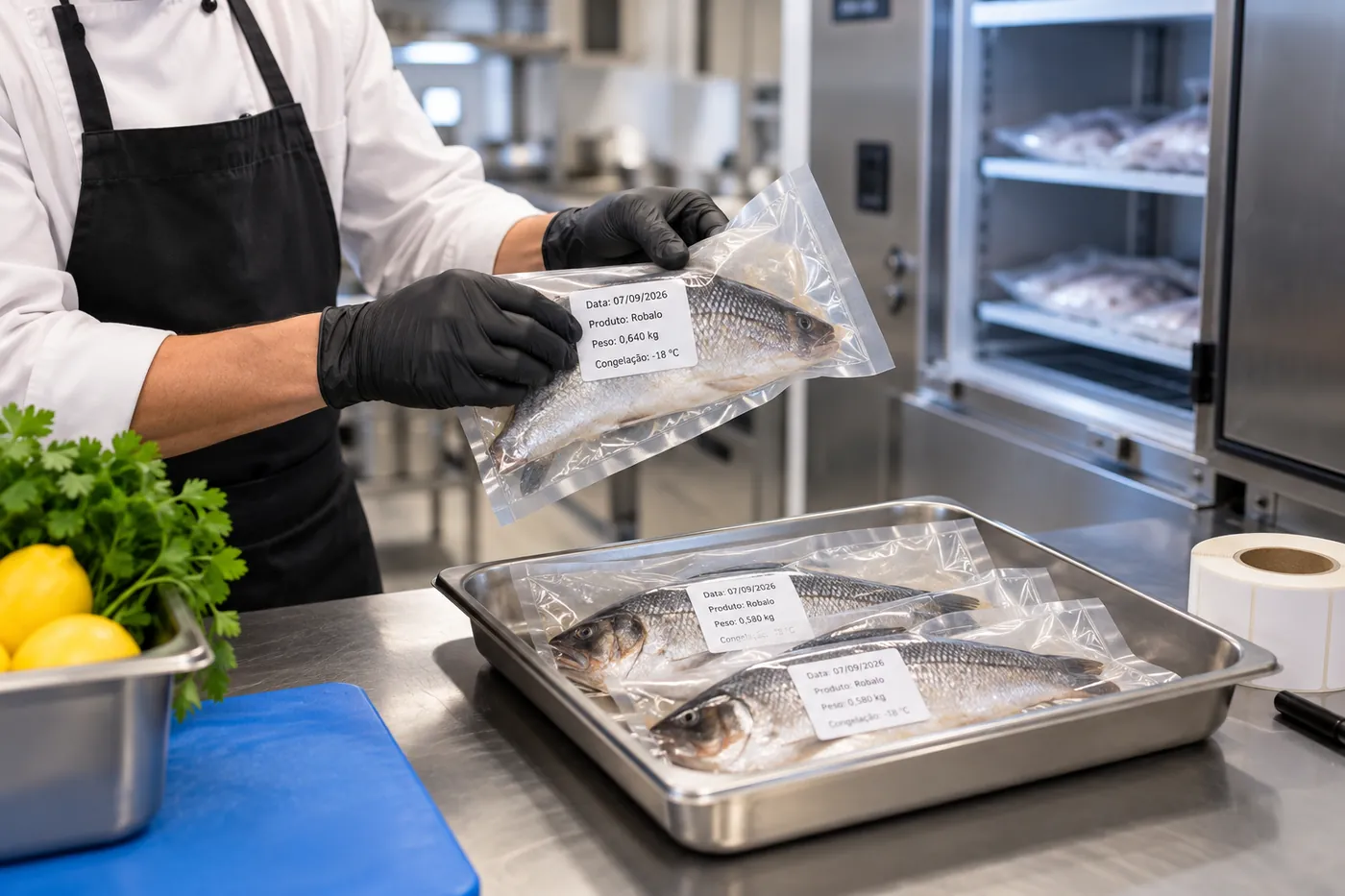
Every frozen product should be labelled with, at a minimum:
- Product name
- Freezing date
- Shelf life while frozen (varies by food type)
- For fish intended to be eaten raw: confirmation that the -20°C/24h or -35°C/15h treatment was applied
This labelling is what allows you, during an inspection, to quickly demonstrate that the process was controlled — and it also underpins traceability in the event of a complaint or incident.
What HACCP Records You Should Keep
For general freezing, the minimum record includes the product, the date it went into the freezer, and the equipment’s temperature at that time. For fish intended to be eaten raw, the record must be more detailed: the exact temperature reached, the start and end time of the treatment, and confirmation that the legal time-temperature binomial was met — this is one of the points ASAE checks most closely in establishments that serve sushi or raw fish.
In Summary
Freezing food in a restaurant is permitted and safe, provided the process is fast, controlled, labelled and recorded. For fish intended to be eaten raw or lightly cooked, the law specifically requires -20°C for 24 hours or -35°C for 15 hours, under Regulamento (CE) n.º 853/2004. Safe thawing — never at room temperature — is just as important as freezing itself, and every batch should be documented in the HACCP system.
Frequently Asked Questions
Can I freeze food that has already been cooked? Yes. You should cool the food correctly first (avoid freezing it while still hot) and then freeze it in portions labelled with the date.
Is it mandatory to freeze fish before serving sushi or raw fish? Yes, under Regulamento (CE) n.º 853/2004, unless the production process itself (for example, certain certified aquaculture methods) already guarantees the parasite’s absence — in practice, most establishments must apply the freezing treatment.
Can I refreeze food after it has thawed? You should not refreeze raw food that has thawed with no cooking step in between. If the food is cooked in the meantime, the resulting cooked dish can be frozen again.
What temperature should a restaurant freezer be? For general storage, -18°C is the usual reference. For the specific treatment of fish intended to be eaten raw, you need to reach -20°C (24h) or -35°C (15h), which may require dedicated equipment with greater cooling capacity.
Make Sure Freezing at Your Establishment Complies with the Law
Serving raw fish without the correct freezing treatment is one of the most serious non-conformities ASAE identifies — and one of those that most exposes customers to real risk.
⚠️ Serving sushi or raw fish without the correct anti-parasitic treatment can result in immediate suspension of activity.
With FiscalControl, you get:
✅ A review of your freezing and thawing process ✅ Ready-to-use HACCP record templates ✅ Compliance confirmation for raw and lightly cooked fish ✅ Direct support in the event of an inspection
No commitment. No small print. Just peace of mind.
We support restaurants, sushi bars and hotels across the Algarve — Faro, Portimão, Albufeira, Lagos, Loulé, Tavira and Vilamoura.
FiscalControl | R. Primeiro de Junho 9 2º C, 8150-111 São Brás de Alportel
Leave a Reply