

Published on 9 October 2026 · Reviewed by the FiscalControl technical team, a HACCP and food safety consultancy in the Algarve.
Direct answer: Yes — you should review your HACCP plan whenever the supplier, the ingredient, the process or the space changes. Regulation (EC) No 852/2004 requires the operator to review HACCP procedures whenever a change is introduced to the product, the process or any stage of the operation. A new supplier, a different ingredient, a changed recipe, new equipment or a change to the space can introduce hazards that the current plan doesn’t control — especially allergens. In most cases there’s no need to redo the whole plan: it’s enough to review the affected stages, update the technical data sheets and allergen information, train the team, and keep the review documented.
What the Law Says: the HACCP Plan Is Not a Closed Document
Many restaurants treat HACCP as a dossier that’s put together once, when they open, and then left on a shelf. The law says otherwise. Article 5 of Regulation (EC) No 852/2004 states that, whenever there is a change to the product, the process or any stage, the operator must review the procedures and introduce the necessary changes.
In other words, a HACCP plan is only valid for as long as it describes the actual operation. If the kitchen has changed and the plan hasn’t, the plan has stopped doing its job — and in an ASAE inspection, that gap between paper and practice is one of the first things to show up.
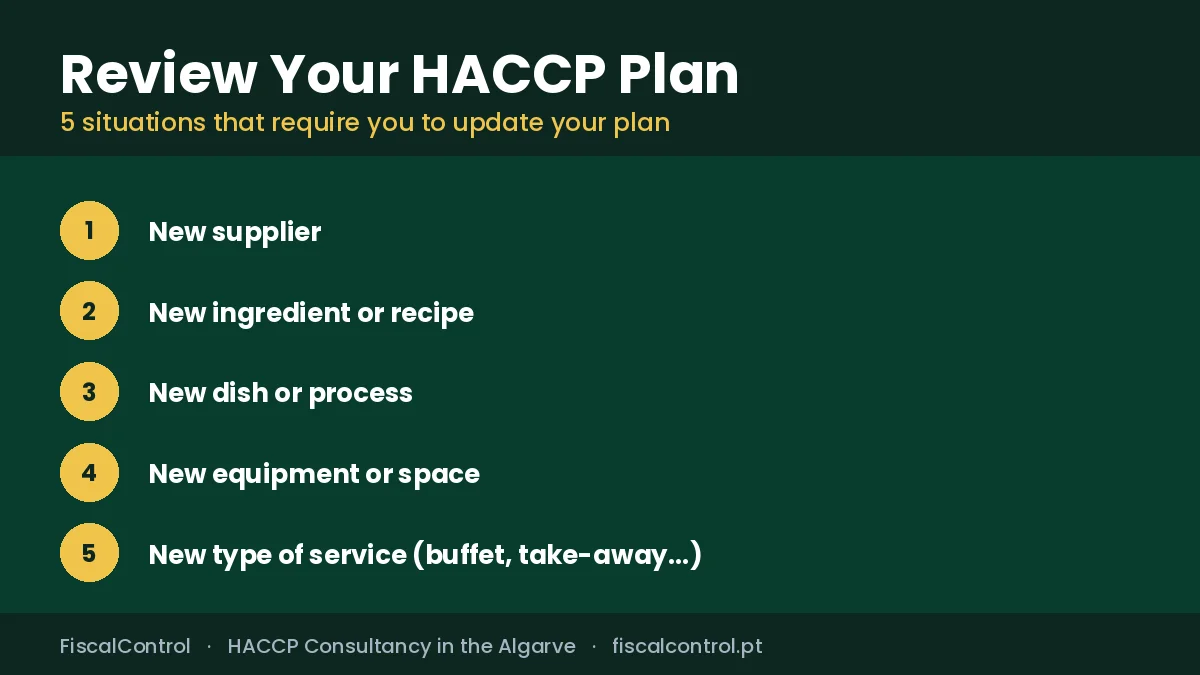
Five Changes That Require You to Review the Plan
New Supplier
Even if the product is “the same”, a different supplier can bring a different composition, different packaging, a different delivery temperature or a different shelf life. You need to confirm the product’s technical data sheet, the receiving conditions and traceability — and add the supplier to your list of approved suppliers.
New Ingredient or Recipe Change
This is the change with the highest hidden risk. Switching the brand of breadcrumbs, pesto or a sauce can introduce an allergen that wasn’t in the dish before — and the information given to the customer becomes wrong immediately.
New Dish or New Process
Introducing raw fish, sous-vide cooking, home smoking, advance preparation or desserts with raw egg adds hazards and, often, new critical control points, with their own limits and records.
New Equipment or Change of Space
A blast chiller, a new cold room or kitchen renovations change layouts, timings and control points. Your floor plan, cleaning schedules and temperature records all need to be updated to match.
New Type of Service
Starting take-away, delivery, events or a buffet brings new stages — packaging, transport, extended display — that the original plan didn’t anticipate.
Allergens: the Risk That Changes Without Anyone Noticing
Regulation (EU) No 1169/2011 requires customers to be given information on the 14 allergens that must be declared, including for non-prepacked food served in restaurants. Since the change introduced by Regulation (EU) 2021/382, Regulation (EC) No 852/2004 also includes explicit requirements for managing allergens in the kitchen, to prevent cross-contact.
The problem is that allergens change with the raw material, not with the name of the dish. The “bitoque” steak is still called a bitoque, but if the sauce now comes from a different supplier and contains mustard or soy, the technical data sheet and the menu information are wrong. So whenever an ingredient or supplier changes, the rule is simple: read the label or technical data sheet of the new product and update the allergen matrix on the same day.
How to Review Your HACCP Plan Without Starting From Scratch
To review your HACCP plan without wasting time, a good review is proportionate to the change. For most day-to-day changes, these steps are enough:
- Identify what changed — supplier, ingredient, recipe, process, equipment or space.
- Review the hazard analysis for the affected stages — are there new hazards? Has any critical limit or control method changed?
- Update technical data sheets and the allergen matrix — before the dish is served again.
- Adjust records and forms — new temperatures, new equipment, new suppliers on the receiving sheet.
- Inform and train the team — kitchen and front of house, especially when the change affects allergens.
- Document the review — date, what changed, what was reviewed and who approved it. This is the evidence that shows, in an inspection, that the plan is alive.
Even without changes, it’s good practice to review the plan at least once a year and always before the start of the high season. This frequency is a technical recommendation, not a legal deadline.
Most Common Mistakes
- Switching brands “because it was on offer” without checking the ingredient list
- Updating the menu and forgetting the allergen matrix, leaving front-of-house giving customers the wrong information
- Buying new equipment and still logging temperatures on the old form
- Reviewing the HACCP plan without leaving a record of the review, which, for inspection purposes, is the same as not having reviewed it at all
In Summary
In short: you need to review your HACCP plan whenever the supplier, the ingredient, the process, the equipment or the space changes. Regulation (EC) No 852/2004 requires the HACCP plan to keep matching the real operation, and a review doesn’t have to be complicated — it has to be proportionate, done on time, and documented.
Frequently Asked Questions
Do I have to review the HACCP plan every time I change supplier? You need to check whether the change affects the plan. If the product has a different composition, different delivery conditions or different allergens, the plan and technical data sheets need to be updated. If everything stays the same, it’s enough to record the new supplier on your list of approved suppliers.
Does changing the brand of an ingredient require updating the allergen information? It may. Similar products from different brands often have different compositions. Whenever you change brand, you should read the label or technical data sheet and confirm the allergen matrix before serving the dish.
How often should the HACCP plan be reviewed? The law doesn’t set a fixed frequency: it requires a review whenever there are changes. As good practice, a full review is recommended at least once a year and before the high season. Even so, you should review the HACCP plan whenever a relevant change occurs in the operation.
How do I prove in an inspection that the plan has been reviewed? With a record of reviews kept with the plan itself: date, the change that triggered the review, the stages reviewed and who approved it, together with the updated technical data sheets and allergen matrix.
Keep Your HACCP Plan in Step With Your Kitchen
Changing menus, rotating suppliers and new equipment are part of any restaurant. What can’t happen is the HACCP plan falling behind.
⚠️ A HACCP plan that doesn’t match the real kitchen is a non-conformity — and outdated allergen information is a direct risk to your customers.
With FiscalControl, you get:
✅ Review of your HACCP plan whenever the menu, supplier or process changes ✅ Updated technical data sheets and allergen matrix ✅ A review record ready to show at an inspection ✅ Training for kitchen and front-of-house staff
No commitment. No small print. Just peace of mind.
We support restaurants and hotels across the country, with a strong presence in the Algarve — Faro, Portimão, Albufeira, Lagos, Loulé, Tavira and Vilamoura.
FiscalControl | R. Primeiro de Junho 9 2º C, 8150-111 São Brás de Alportel
Leave a Reply