Updated on 25 September 2026 · Reviewed by the FiscalControl technical team, a HACCP-certified consultancy in the Algarve.
Direct answer: No. “May contain traces of…” is a precautionary statement (precautionary allergen labelling) that should only be used when there is a real risk of cross-contamination, backed by a serious risk assessment — it is not a generic disclaimer that replaces the legal obligation to correctly identify the 14 allergens that must be declared in every dish, under Regulamento (UE) n.º 1169/2011 and Decreto-Lei n.º 26/2016. Used indiscriminately (“our dishes may contain traces of everything”), the phrase offers the establishment no legal protection and can, on the contrary, be read as a sign of poor allergen management.
What the Law Requires: the 14 Allergens That Must Be Declared
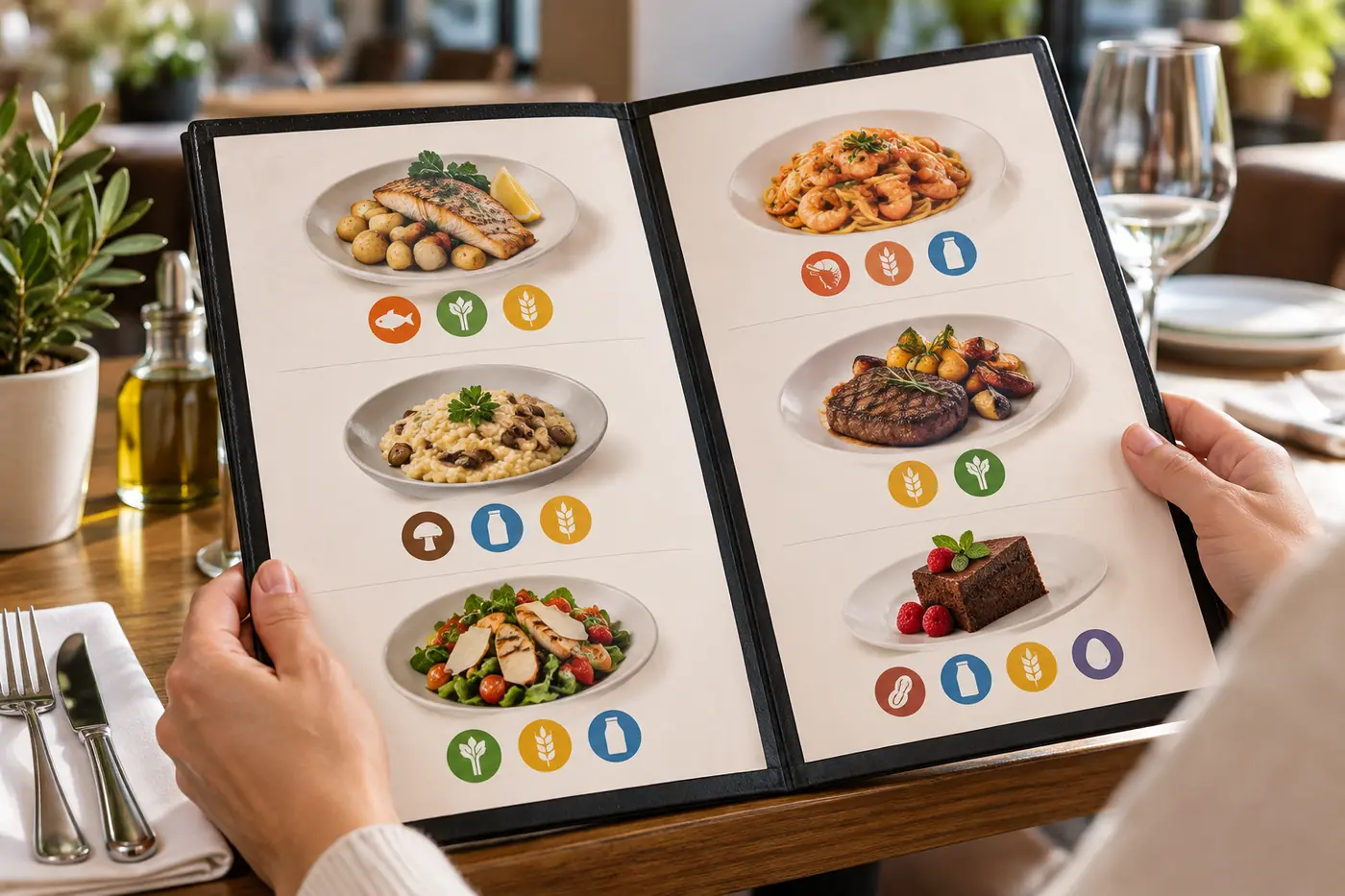
Regulamento (UE) n.º 1169/2011, supplemented in Portugal by Decreto-Lei n.º 26/2016, requires 14 groups of allergens to be identified whenever they are present as an intentional ingredient in a dish — gluten, crustaceans, eggs, fish, peanuts, soy, milk, tree nuts, celery, mustard, sesame seeds, sulphur dioxide and sulphites, lupin and molluscs. This obligation applies to both pre-packaged food and non-pre-packaged food served in food service settings — in other words, to any restaurant or hotel menu.
This is a positive obligation: identifying what is in the dish. It is different from the “may contain traces of” statement, which refers to unintentional contamination.
What Precautionary Allergen Labelling (PAL) Actually Means
“Precautionary allergen labelling” (PAL) exists to signal that, despite all preventive measures, there remains a real risk of cross-contamination that a risk assessment was unable to eliminate. The European Commission is clear on this point: precautionary labelling should only be applied if a risk assessment demonstrates that this risk actually exists — not as an automatic form of legal cover.
Unlike the 14 mandatory allergens, the EU does not set a single numerical threshold or a mandatory wording for precautionary labelling. This means it is up to each operator to demonstrate that they carried out that risk assessment — and this is precisely where most establishments fall short.
Why “May Contain Traces of Everything” Protects No One
It’s common to see menus with a generic note along the lines of “our dishes may contain traces of all allergens” at the bottom of the menu. This practice has three serious problems:
- It is not a real risk assessment. If there has been no concrete exercise identifying where, in the kitchen, a genuine risk of cross-contamination exists for each specific allergen, the generic statement is just an attempt to shift responsibility — it does not meet the spirit of the EU rules on PAL.
- It harms people with real allergies. A customer with a serious allergy, faced with a menu where “everything may contain everything”, is left with no useful information to make a safe decision — which, in practice, can push them towards a more transparent establishment instead.
- It does not remove civil liability. In the event of a serious allergic reaction, a court or ASAE will not just check whether the phrase was printed on the menu, but whether the establishment actually had a credible allergen management system behind that phrase.
When the Statement Is Justified
Precautionary labelling makes sense, for example, when:
- The same fryer is used for products with and without gluten
- The kitchen regularly handles nuts and there is no fully segregated preparation area
- Suppliers cannot guarantee the absence of cross-contamination in a specific ingredient (e.g., ground spices processed on the same lines as sesame products)
In these cases, the statement should be specific to the allergen actually at risk — “may contain traces of gluten” — rather than a generic list of every possible allergen.
How to Manage Allergens Correctly (Without Relying Solely on the Statement)
- An allergen map per dish, updated whenever an ingredient, supplier or recipe changes
- Physical or time-based separation of risk processes (e.g., frying gluten-free items before, not after, gluten-containing ones)
- Supplier technical data sheets confirming the presence or absence of allergens in each raw material
- Training for front-of-house staff to answer customer questions about allergens accurately — the failure often isn’t in the kitchen, but in the waiter’s verbal answer
- A record of the risk assessment that justifies each precautionary statement used on the menu
In Summary
The phrase “may contain traces of…” only has legal and practical value when it results from a real cross-contamination risk assessment — not as a generic disclaimer. The underlying obligation remains to correctly identify the 14 allergens that must be declared in every dish, under Regulamento (UE) n.º 1169/2011 and Decreto-Lei n.º 26/2016. An up-to-date allergen map and genuine cross-contamination management protect an establishment far more than any phrase printed on the menu.
Frequently Asked Questions
Is it a legal requirement to include the phrase “may contain traces of”? There is no general legal requirement to include this phrase. Precautionary allergen labelling should only be used when a genuine risk assessment identifies a cross-contamination hazard — it is not an automatic requirement for every establishment.
Can I simply write that dishes may contain all allergens, to protect myself? This is not recommended. This practice does not replace the obligation to correctly identify the allergens actually present in each dish, and it can be read as a lack of serious allergen management in the event of an incident.
What are the 14 allergens that must be declared? Gluten, crustaceans, eggs, fish, peanuts, soy, milk, tree nuts, celery, mustard, sesame seeds, sulphur dioxide and sulphites, lupin and molluscs.
What happens if a customer has a serious allergic reaction to a poorly identified dish? Beyond the consequences for the customer’s health, the establishment can face civil and administrative liability, with the existence (or absence) of a documented allergen management system being a central factor in assessing liability.
Organise Your Establishment’s Allergen Management
A line on the menu is not an allergen management system — and that is exactly what we check during an audit.
⚠️ A serious allergic reaction in a customer, with no documented allergen management system in place, is one of the scenarios with the highest legal exposure for a restaurant.
With FiscalControl, you get:
✅ An allergen map adapted to your menu ✅ A cross-contamination risk assessment for your kitchen ✅ Training for front-of-house and kitchen staff ✅ Direct support in the event of an inspection or customer complaint
No commitment. No small print. Just peace of mind.
We support restaurants and hotels across the Algarve — Faro, Portimão, Albufeira, Lagos, Loulé, Tavira and Vilamoura.
FiscalControl | R. Primeiro de Junho 9 2º C, 8150-111 São Brás de Alportel
Leave a Reply