

Published on 22 October 2026 · Reviewed by the FiscalControl technical team, HACCP and food safety consultants in the Algarve.
Direct answer: HACCP delivery and takeaway rules apply in full. Restaurants offering delivery or takeaway, and dark kitchens selling only through platforms, must follow the same hygiene rules as any other professional kitchen under Regulation (EC) No 852/2004. Their HACCP plans must also cover stages absent from table service: packaging, waiting for collection, handover to a courier and transport. The three priorities are keeping food at a safe temperature until it reaches the customer, using suitable tamper-evident packaging, and making allergen information available before purchase and at delivery, as Regulation (EU) No 1169/2011 requires for distance selling.
HACCP Delivery Rules: The same rules, with extra stages in the plan
There is no separate “delivery HACCP”. Anyone preparing meals for delivery is a food business operator and must meet Regulation (EC) No 852/2004 just like a restaurant with a dining room. What changes is the food’s journey: between the kitchen pass and the customer’s door come packaging, waiting, an external person and a trip. Each stage can introduce hazards that the HACCP plan must identify and control.
Many restaurants began delivering meals without updating their plans. This is a clear example of a change in service that requires a HACCP review.
Takeaway, delivery and dark kitchens: the differences
Takeaway
The customer collects the meal at the counter. The restaurant controls preparation, packaging and handover; the customer then handles transport. Focus on the packaging, the time between preparation and collection, and allergen information.
Delivery by restaurant or platform couriers
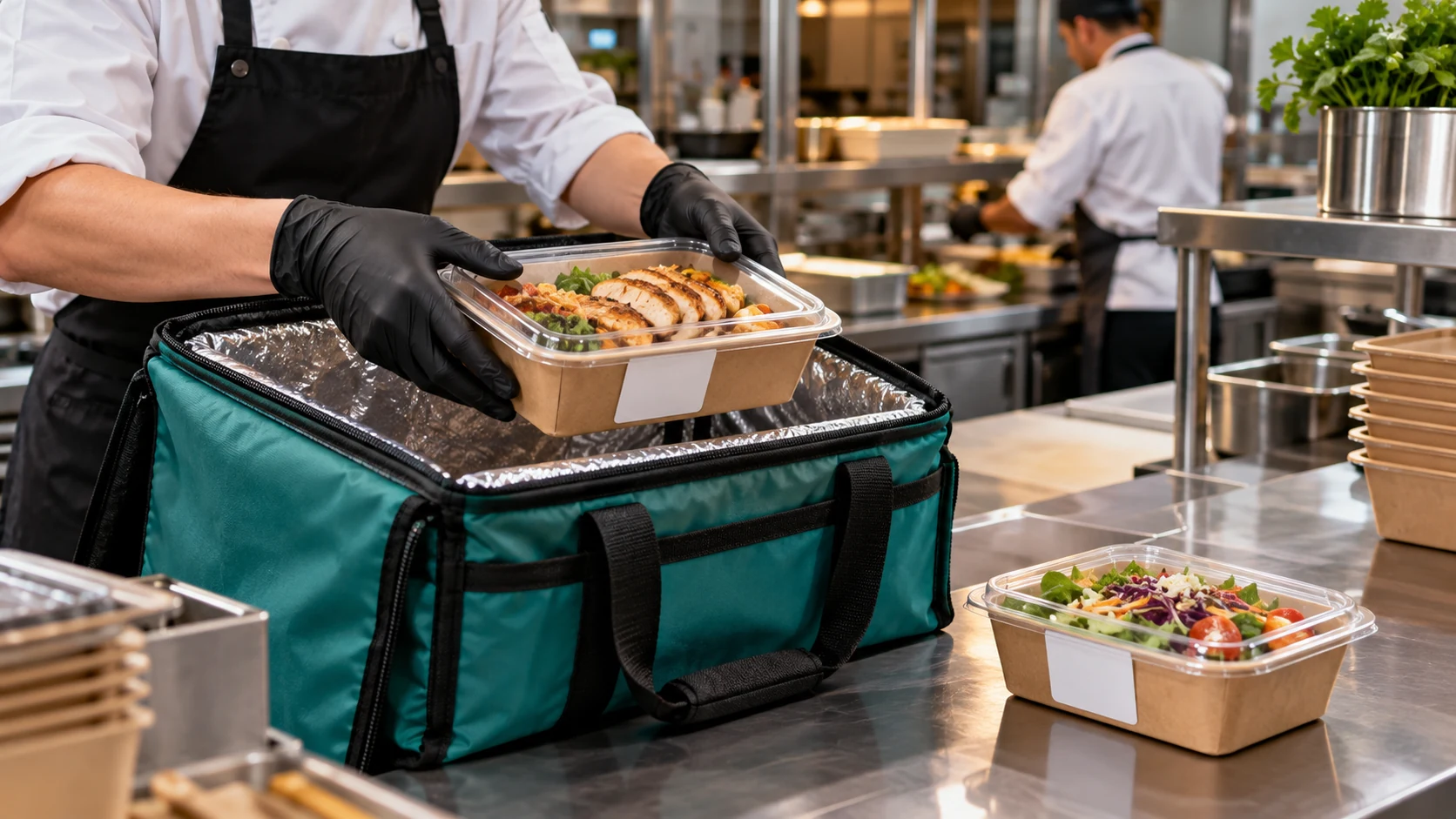
Delivery adds a transport stage. Even when a platform provides the courier, the restaurant should hand over food in packaging that protects it during the trip. Set written transport requirements: clean insulated bags or boxes, separation of hot and cold food, and a maximum waiting time.
Dark kitchens
Dark kitchens have no dining room and prepare food only for delivery, sometimes under several virtual brands in the same space. Their hygiene duties are those of any professional kitchen. Multiple menus prepared at the same workstations increase the number of allergens in circulation and the risk of cross-contact.
Critical points for a delivered meal
- Prepare in line with orders. Preparing meals too early increases the time food spends at unsafe temperatures before it reaches the customer.
- Use suitable packaging. Choose food-contact materials appropriate for the product temperature and seals that show if a package has been opened. Pack hot and cold food separately.
- Control the wait for the courier. Set aside a collection area outside the food-preparation space where meals can wait at controlled temperatures.
- Control transport. Annex II, Chapter IV of Regulation (EC) No 852/2004 requires transport containers to be clean and food to be kept at appropriate temperatures. Common HACCP plan reference points are above 65 °C for hot food and below 5 °C for cold food.
- Set a maximum delivery time. Define the time from the end of preparation to customer handover, especially for sensitive dishes such as seafood, raw fish, mayonnaise and egg-based desserts.
Allergens in distance selling: before purchase and at delivery
Article 14 of Regulation (EU) No 1169/2011 covers distance selling. Mandatory food information, including information on the 14 allergens, must be available before the customer completes the purchase, not only when the meal arrives.
The menu on a delivery platform or website should show the allergens in each dish, or clearly explain how customers can obtain that information before ordering. Keep it current: if a sauce or supplier changes, update the platform listing the same day. Allergen information should also be accessible on delivery, for example on a package label.
When an order contains several dishes, label each package so a customer with an allergy can identify their own meal.
Who is responsible when a delivery platform is involved?
A delivery platform is an intermediary; it does not take over responsibility for the safety of a meal prepared by the restaurant. The restaurant is responsible for preparation, packaging, the allergen information it gives to the platform and the condition of the meal at handover. Keep evidence such as dispatch times, temperatures of sensitive dishes and records of when the platform menu was reviewed.
Common delivery and takeaway mistakes
- A platform menu with no allergen information or out-of-date details.
- Hot and cold food packed together in the same bag or container.
- Couriers entering the kitchen to collect orders.
- Meals prepared long before a courier arrives and left at room temperature.
- A HACCP plan that never included packaging and delivery stages.
In summary
Delivery, takeaway and dark kitchens follow the same kitchen hygiene rules under Regulation (EC) No 852/2004, but their HACCP plans must cover packaging, waiting and transport. Allergen information must be available before purchase and at delivery under Article 14 of Regulation (EU) No 1169/2011. Using a delivery platform does not remove the restaurant’s responsibility for the meal it prepares.
Frequently asked questions
Must a restaurant update its HACCP plan when it starts delivery?
Yes. Delivery adds packaging, waiting and transport stages, which must be analysed and controlled in the HACCP plan.
Must allergens appear on the delivery platform?
Allergen information must be available before the customer completes the purchase. Listing it for each dish on the platform is the clearest approach.
Who is responsible if the food arrives in poor condition?
The restaurant is responsible for preparation, packaging and the meal’s condition when it is handed to the courier. It should define transport requirements and keep dispatch-time and temperature records.
Does a dark kitchen need a HACCP plan?
Yes. A dark kitchen is a food business operator like any restaurant and needs procedures based on HACCP principles, with particular attention to allergens when several brands share a space.
Deliver meals as safely as you serve them
Every order carries your restaurant’s name to the customer’s home. A HACCP plan that covers delivery protects customers and your reputation on the platforms.
⚠️ Missing allergens on a platform menu are a non-conformity, and an allergic reaction to a delivered meal can rapidly become a public complaint.
With FiscalControl, you get:
- ✅ A HACCP plan updated for packaging, waiting and transport.
- ✅ An allergen matrix ready for delivery platforms.
- ✅ Written rules for couriers and the collection area.
- ✅ Simple dispatch-time and temperature records.
👉 Request a free quote within 24 hours
No commitment. No small print. Just peace of mind.
We support restaurants and hotels throughout Portugal, with a strong presence in the Algarve — Faro, Portimão, Albufeira, Lagos, Loulé, Tavira and Vilamoura.
FiscalControl | R. Primeiro de Junho 9 2º C, 8150-111 São Brás de Alportel
Leave a Reply