

Published on 15 October 2026 · Reviewed by the FiscalControl technical team, a HACCP and food safety consultancy in the Algarve.
Direct answer: A poorly controlled hotel breakfast buffet is one of the biggest sources of risk in a hotel. The breakfast buffet is one of the highest-risk stages in a hotel because it combines prolonged exposure, continuous replenishment and hundreds of guests serving themselves with the same utensils. The most common mistakes are keeping hot dishes below a safe temperature, leaving cold items out of refrigeration, topping up trays over food that’s already been on display, sharing tongs between different foods, and not labelling allergens. As a standard reference in HACCP plans, hot dishes should stay above 65°C and cold ones below 5°C, with maximum display times defined and recorded.
Why the Buffet Is a Critical Point in the Hotel
In the kitchen, the team controls who touches the food and how long it stays on display. At the buffet, that control partly shifts to the guest. Food sits exposed for hours, is served by many hands, and is replenished at the pace of the dining room. That’s why a well-run hotel breakfast buffet needs clear rules and records to prove it.
In the Algarve, high season multiplies the problem: dining rooms full between 7:30 and 10:30, teams reinforced with seasonal staff, and guests of dozens of nationalities, many with allergies or intolerances and not speaking Portuguese. This is exactly the scenario where small deviations add up.
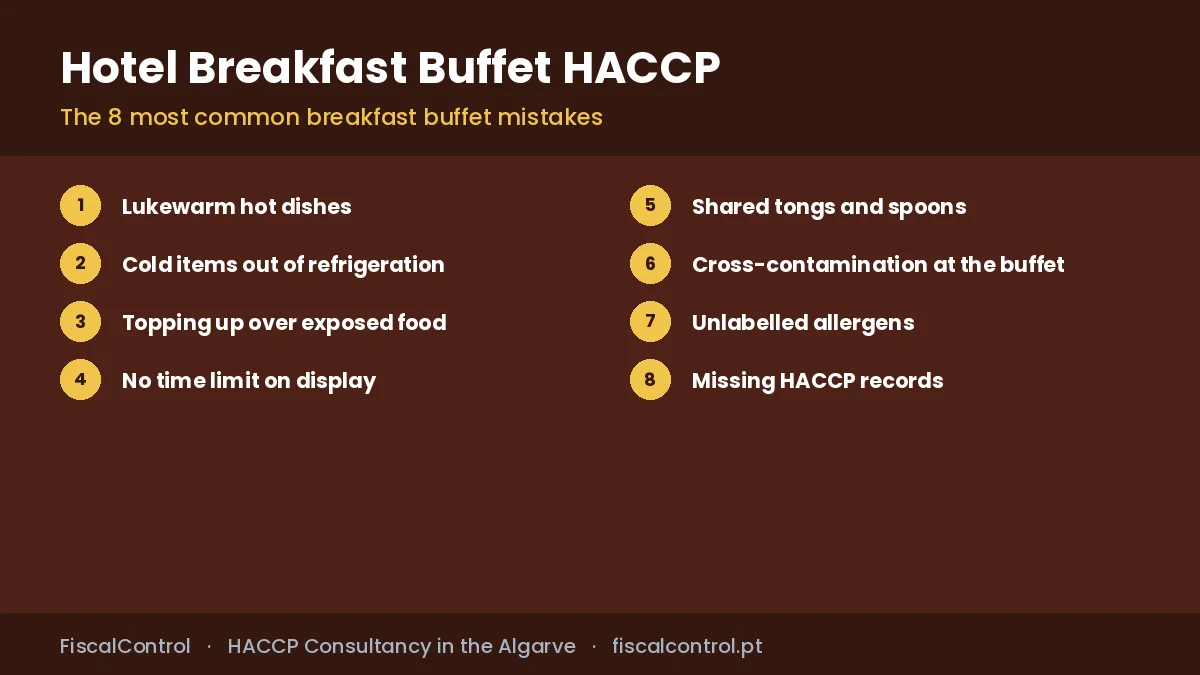
The Eight Most Common Breakfast Buffet HACCP Mistakes
1. Lukewarm Hot Dishes
Scrambled eggs, sausages, bacon and beans in a bain-marie with no temperature control. A bain-marie keeps food hot, but doesn’t heat up food that arrived lukewarm. Temperature should be measured with a probe at the centre of the food, at the start of service and at regular intervals.
2. Cold Items Out of Refrigeration
Cold cuts, cheeses, yoghurts, smoked salmon and cut fruit displayed on platters with no refrigeration, or on ice that has already melted. Ready-to-eat products such as smoked salmon and sliced cold cuts need special attention for Listeria monocytogenes, whose rules changed in July 2026.
3. Topping Up Instead of Replacing
Adding freshly made eggs on top of ones that have been on display for an hour mixes batches and indefinitely extends the exposure of the first batch. The rule is to swap the whole tray and remove the previous one.
4. No Time Limit on Display
Without a defined maximum time, food that has already been on display goes back into the fridge and reappears the next day. The HACCP plan should set how long each type of food can stay on the buffet and what happens to leftovers — in practice, disposal.
5. Shared Tongs and Spoons
Tongs that go from the cheese to the bread, or a spoon that jumps from the granola to the yoghurt, transfer allergens between foods. Each container needs its own utensil, and utensils should be swapped frequently.
6. Unlabelled Allergens
Regulation (EU) No 1169/2011 requires allergen information for the 14 allergens that must be declared, including for non-prepacked food. At a buffet, the most effective way to do this is a label next to each food item, with allergen icons and text in several languages — especially at a hotel with an international clientele.
7. Egg Station With No Separation Between Raw and Cooked
At the omelette and made-to-order egg station, the same cook handles raw eggs and serves finished dishes. Surfaces and utensils need to be kept separate, hands washed between tasks, and raw eggs kept refrigerated until the moment they’re used.
8. Buffet With No Protection or Supervision
Without sneeze guards and without a staff member paying attention to the buffet line, no one notices the guest who puts food back on the platter, the spoon that fell into the yoghurt, or the temperature that has dropped.
Quick Checklist for the Breakfast Manager
- Hot and cold equipment switched on and at temperature before the room opens
- Temperatures measured with a probe and recorded at opening and at set intervals
- Display start time identified for each tray
- Replenishment by swapping trays, never by topping up
- One utensil per container, with clean spare utensils available
- Correct, up-to-date allergen labels for each food item
- Leftover disposal decided and recorded at closing
What HACCP Records the Buffet Should Have
The minimum an ASAE inspection expects to find is a daily record with the temperatures of equipment and food on display, the start and end time of display, any deviations detected and the corrective actions taken — for example, “scrambled eggs at 52°C at 9:15am, removed and replaced”. When breakfast is run by seasonal staff, this sheet is also the best training tool: it shows, every day, what needs to be checked.
The values of 65°C and 5°C given in this article are standard references in HACCP plans and good-practice guides. Each hotel’s actual limits should be defined and justified in its own plan. Whenever the supplier, recipe or equipment used at the buffet changes, that plan needs to be reviewed.
In Summary
In short: a hotel breakfast buffet requires control of temperature, display time and allergens. The breakfast buffet is a stage of the HACCP plan with its own hazards: temperature, exposure time, cross-contamination and allergens. Regulation (EC) No 852/2004 requires these hazards to be controlled and recorded, and Regulation (EU) No 1169/2011 requires allergen information to be made available to guests. Hot above 65°C, cold below 5°C, defined display times, tray-swap replenishment, one utensil per container and correct allergen labels solve most of the problems.
Frequently Asked Questions
What temperature should hot dishes be at a buffet? As a standard reference in HACCP plans, above 65°C, measured with a probe at the centre of the food. A bain-marie keeps food hot — it doesn’t heat up food that arrived lukewarm.
Can leftover buffet food be used again the next day? Food that has been exposed to guests should not be reused. Only food that never left the kitchen or the cold room, and that stayed at the correct temperature, can be used again.
Is it mandatory to label allergens at the buffet? Yes. It’s mandatory to make information on the 14 allergens available, under Regulation (EU) No 1169/2011. At a buffet, a label next to each food item is the most effective way to do this, and the easiest to demonstrate at an inspection. This is one of the most closely checked rules in any audit of a hotel breakfast buffet.
How long can food stay on display at the buffet? The law doesn’t set a single time limit. Each hotel should define, in its HACCP plan, a maximum time per type of food, ensure the temperature is maintained throughout that period, and discard whatever is left over.
A Safe Buffet Starts Before the Room Opens
Guests remember breakfast — for good reasons or bad ones. A well-controlled buffet protects your guests, your team and your hotel’s reputation.
⚠️ A single allergen incident or a case of food poisoning at breakfast can cost far more than a fine: it costs reviews, bookings and the trust of tour operators.
With FiscalControl, you get:
✅ A HACCP plan that treats the buffet as its own stage ✅ Simple record sheets for temperatures and display times ✅ Allergen labelling adapted to an international clientele ✅ Training for seasonal staff before the high season
No commitment. No small print. Just peace of mind.
We support restaurants and hotels across the country, with a strong presence in the Algarve — Faro, Portimão, Albufeira, Lagos, Loulé, Tavira and Vilamoura.
FiscalControl | R. Primeiro de Junho 9 2º C, 8150-111 São Brás de Alportel
Leave a Reply