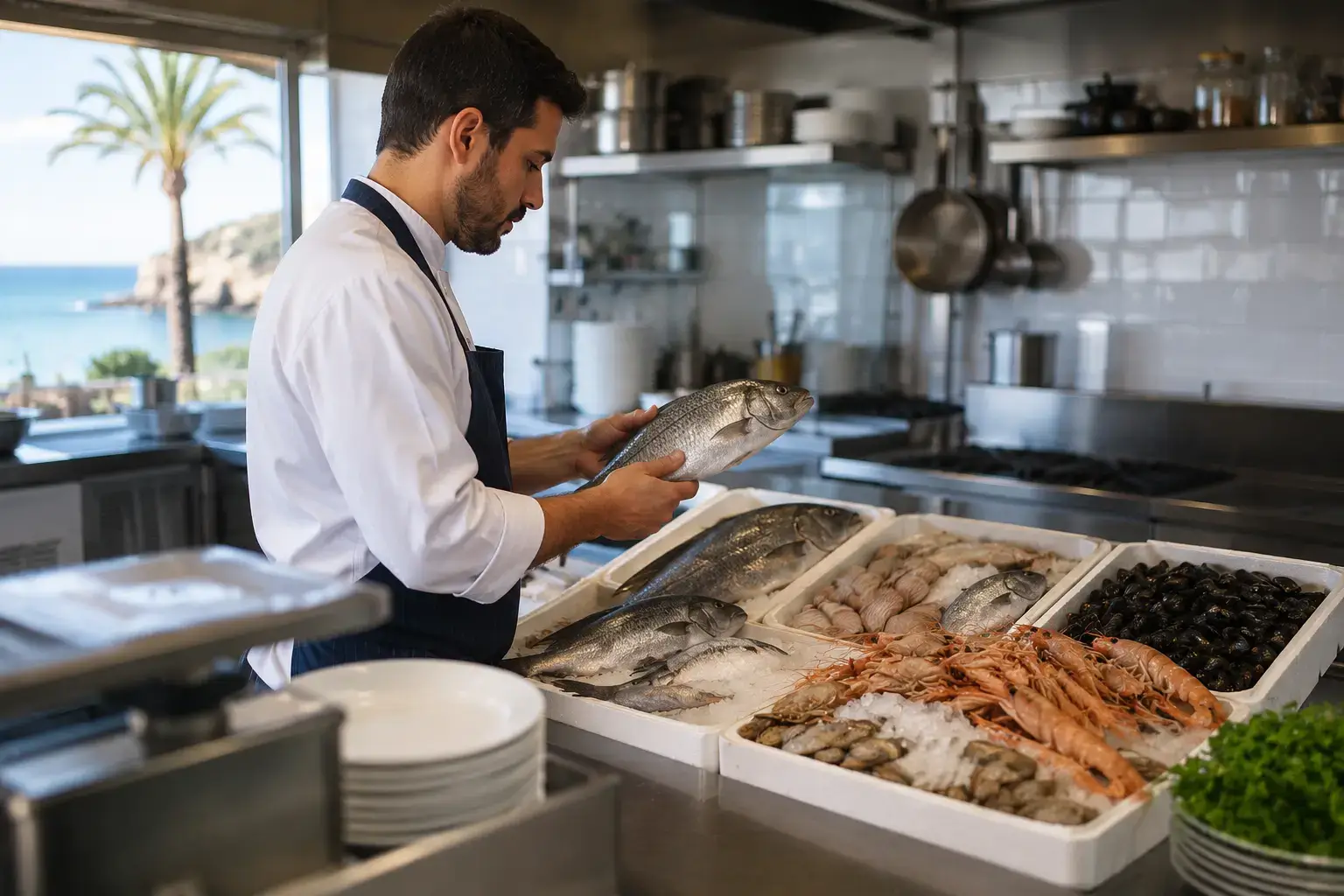
Restaurants in Faro, Albufeira, Loulé, Olhão, Tavira and along the entire Algarve coast rely on the quality and freshness of their fish and seafood as one of their greatest points of difference. Clams à Bulhão Pato, Berlenga barnacles, grilled sole, roasted sardines — the Algarve is gastronomically inseparable from the sea.
That’s precisely why food legislation applied to fish and seafood is one of the areas where doubts — and infractions — arise most often at restaurants in the region. Questions we regularly receive from operators in Faro, Albufeira and Loulé:
- “Can I use fish I caught myself at my restaurant in Albufeira?”
- “Can the clams I gather over there in the Ria Formosa in Faro go straight into the kitchen?”
- “Do I have to put the bivalves in water to clean before serving them in Loulé?”
- “Can I serve small petingas at my restaurant?”
The answers aren’t always what you’d expect.
Recreational Fishing in Algarve Restaurants: A Ban Many Don’t Know About
National legislation is unambiguous: it is forbidden to use fish from recreational fishing in any commercial establishment, including restaurants in Faro, Albufeira, Loulé or any other Algarve municipality.
The law expressly prohibits displaying for sale, offering for sale or selling marine species caught under recreational fishing (whether leisure, sport, or tourist fishing).
This means that even if the owner of a restaurant in Albufeira is a keen angler with a recreational fishing licence and brings in the day’s fresh catch straight from the sea, it cannot be used in the restaurant — not even as a complimentary offering, nor as an ingredient in a dish.
The reason is traceability and health control: fish and seafood sold commercially must pass through controlled channels that guarantee compliance with hygiene standards, minimum sizes and catch conditions.
Clams and Cockles from the Ria Formosa (Faro) or the Algarve Coast: A Lesser-Known Ban
This point is especially relevant for restaurants in Olhão, Faro and Tavira, where the Ria Formosa provides easy access to excellent-quality bivalves:
It is forbidden to serve live bivalve molluscs from “local gathering” unless they have first gone through an approved dispatch centre — even if the gathering is local and in small quantities.
Under EU legislation, all live bivalve molluscs (clams, cockles, mussels, oysters, barnacles) must:
- Go through an approved dispatch and/or purification centre
- Undergo health safety checks
- Be packaged in a tamper-proof net bag with proper labelling
- Never be sold directly from the gatherer to the restaurant
There is no exception in the legislation for local gathering or small quantities — not for bivalves from the Ria Formosa in Faro, nor for those from the Albufeira coast, nor for those from the Guadiana estuary in Vila Real de Santo António.
Is It Forbidden to Keep Bivalves in Trays of Water?
Yes — and the ban is unambiguous, with particular impact on seafood restaurants in Faro, Olhão and Albufeira that are in the habit of placing clams in salt water before serving:
Once live bivalve molluscs have left the dispatch centre and been packaged, they must not be re-immersed in or sprayed with water — including seawater.
Bivalves arriving at the restaurant have already been through a controlled purification process. Dipping them in water again can re-contaminate products already declared fit for consumption.
Correct storage at Algarve restaurants:
- In the original, sealed packaging
- In a cool place (between 2°C and 8°C)
- Without re-immersion in water
- For the shortest possible time between receipt and use
Petingas and Joaquinzinhos: Can They Be Served at Algarve Restaurants?
Yes — but subject to mandatory minimum sizes. This is a question with particular relevance for fish restaurants in Faro, Albufeira and along the whole Algarve coast:
| Species | Popular name in the Algarve | Minimum size |
|---|---|---|
| Sardine (Sardina pilchardus) | Petinga | 11 cm |
| Horse mackerel (Trachurus trachurus) | Joaquinzinho | 15 cm |
Regulated exception: EU legislation allows the landing of horse mackerel between 12 and 14 cm in length under certain conditions. What matters is that fish and seafood are always sourced through authorised commercial channels — fish markets, fish auctions (lota), licensed suppliers.
For restaurants in Albufeira and Faro that make fish quality their point of difference, sourcing via the fish auction in Portimão, Lagos or Olhão guarantees both freshness and legal compliance.
Wild Game Meat in Inland Algarve Restaurants
While not seafood, this question is especially relevant for restaurants in inland Algarve — Loulé, São Brás de Alportel, Monchique, Silves — where hunting is part of the culinary tradition:
Restaurants may serve wild game meat, but under certain conditions:
- All wild game meat sold must carry the Health Mark, following inspection by an Official Veterinarian at a duly licensed Game Handling Facility
- Hunters themselves may supply small quantities directly to restaurants, according to the species and quantities set out in Article 7 of Portaria 74/2014, de 20 de março
- Big game species (wild boar, red deer, fallow deer, roe deer, mouflon) are not covered by the small-quantity exception. To be served at restaurants in Loulé or Silves, they must pass through a licensed establishment
Reused Frying Oil in the Algarve: The Fried Fish Case
A very common practical question at Algarve restaurants serving fried fish: can the same oil be used for both fish and chips?
Portuguese legislation does not prohibit using the same oil for different foodstuffs. However, frying oil must not exceed a polar compound content of 25% — which limits excessive reuse.
A practical note: oil used to fry fish absorbs compounds from the fish. Chips fried in fish oil pick up a fishy taste — which rarely goes down well with the customers of a meat restaurant in Loulé.
Best practices in the Algarve:
- Monitor the oil’s condition with polar compound test strips
- Filter the oil after each use
- Replace it when it shows signs of degradation
- Record replacements in the HACCP plan
Fish and Seafood Traceability: A Requirement for All Algarve Restaurants
For all types of fish and seafood, traceability is mandatory (Article 17 of Regulamento (CE) n.º 178/2002). The restaurant must be able to identify:
- Where the fish or seafood came from (supplier, origin, fish auction)
- When it was purchased (transport notes, invoices)
- How it was stored and processed
Suppliers’ invoices and transport notes form the basis of traceability. They must be kept on file and available for ASAE inspection — something checked frequently at restaurants in Faro, Albufeira and Loulé.
FAQ: Fish and Seafood in Algarve Restaurants
Can I buy clams from a local fisherman in Olhão and serve them at my restaurant in Faro?
No. Even if the fisherman gathers them in the Ria Formosa, they must first go through an approved dispatch/purification centre before being sold.
I have a live lobster tank at my restaurant in Albufeira. Do they need special documentation?
Lobsters kept in a tank to be served fresh are fishery products — not aquaculture products. Traceability (the supplier’s invoices) must be ensured and available for inspection.
What happens if ASAE finds I’m using fish from recreational fishing at my restaurant in Loulé?
This is a serious infraction that can result in a formal notice, a fine and seizure of the products.
Can I serve barnacles gathered on the Algarve coast at my restaurant in Albufeira?
Not without them going through an approved dispatch centre. Barnacles are crustaceans and are subject to the same rules on traceability and controlled origin.
Legal Compliance in the Algarve Fish and Seafood Sector — Fiscal Control
Fiscal Control knows the specifics of the food legislation applied to fish and seafood in the Algarve — including the specific rules on bivalves, recreational fishing and traceability that affect hundreds of restaurants in Faro, Albufeira, Loulé, Olhão and across the whole region.

FiscalControl Can Secure Your Establishment’s Compliance Today
Request a free, no-obligation quote. Our team will get in touch with you within 24 hours.
Leave a Reply