Updated on 10 September 2026 · Reviewed by the FiscalControl technical team, a HACCP-certified consultancy in the Algarve.
Yes, you can and should put hot food into the fridge as soon as it stops boiling — there’s no need to wait for it to cool to room temperature first. The food safety rule is the time-temperature binomial: the food must go from above 65°C to below 10°C at the centre of the product within a maximum of 2 hours. Leaving food on the counter for hours “to cool down” is the most common mistake, and the one that most exposes an establishment to contamination from Bacillus cereus, Clostridium perfringens and other bacteria that multiply in the danger zone (between 8°C and 63°C).
This is one of the points where professional kitchens go wrong most often — not from lack of care, but because “common sense” (letting food cool outside the fridge before storing it) is exactly the opposite of what food safety requires.
The Myth of “You Can’t Put Hot Food in the Fridge”
The idea that putting hot food in the fridge “damages the fridge” or “harms other food” is an old piece of home-kitchen folklore that doesn’t hold up — and it is especially dangerous in a professional environment. The real risk isn’t the fridge; it’s the time the food spends in the danger zone before it gets there.
Professional fridges are built to handle an occasional heat load. What they aren’t built to compensate for is a pot of rice left on the counter for three hours “cooling naturally”.
The 65°C → 10°C in 2 Hours Rule
This is the reference time-temperature binomial used in HACCP plans validated in Portugal: the product must go from a temperature above 65°C to below 10°C, at the centre of the largest piece, within a maximum period of 2 hours. After that, it should keep cooling down to 4°C and be stored within that range.
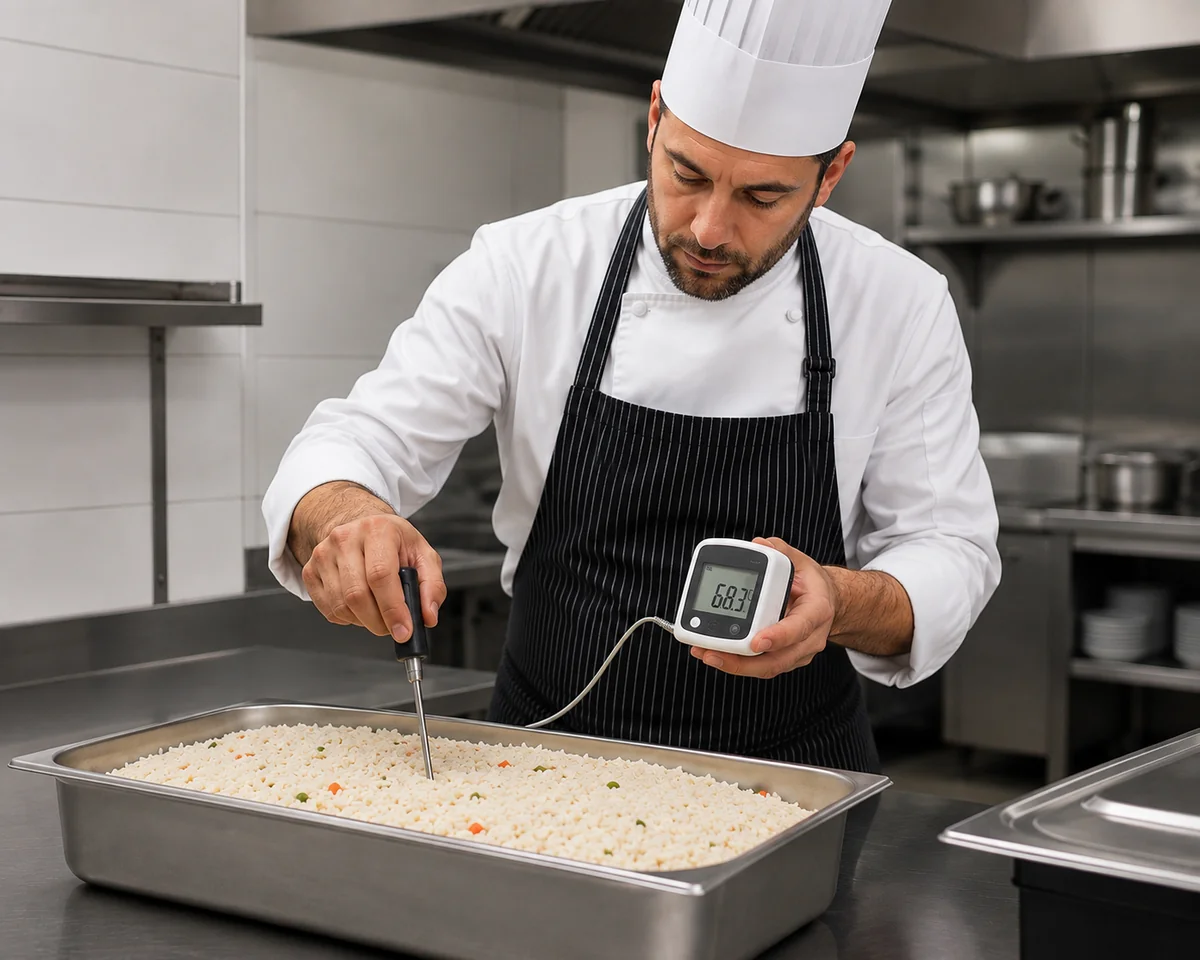
In practice, this means measuring the temperature at the centre of the food — not the surface — with a probe, and recording the start and end time of the cooling process.
Rice, Pasta and Soups: the Most Problematic Cases
Cooked rice and pasta are among the highest-risk foods when it comes to cooling, because Bacillus cereus (naturally present in cereals) survives cooking in spore form and germinates quickly if the food stays warm for hours. Cream- or egg-based soups and sauces carry an equivalent risk.
For these cases:
- Split the large pot into smaller, shallower containers as soon as possible
- Stir soups or sauces periodically to release heat faster
- Never stack hot containers on top of each other in the fridge — it blocks the circulation of cold air
Large Volumes: Banquet Pots and Buffet Production
In higher-volume production — hotel banquets, catering, events — the challenge is greater because the food’s thermal mass takes longer to release heat. The most effective solutions:
- Blast chillers: dedicated equipment that forces the food through the danger zone in minutes rather than hours — the most worthwhile investment for anyone regularly producing large volumes
- Ice bath: submerging the container (without letting water mix with the food) significantly speeds up cooling without specialised equipment
- Splitting batches: always divide production into smaller batches before cooling, even without a blast chiller
The Right Containers: Depth Matters More Than Size
A deep, full container is the worst possible scenario for cooling — the centre of the mass takes a very long time to lose heat, even with the fridge working properly. Practical rules:
- Favour shallow containers (recommended maximum depth: 7-10 cm for dense preparations such as rice or purée)
- Don’t seal the container tightly while the food is still hot — cover it in a way that allows some steam to escape during the first few minutes
- Always label the container with the product and the time it was cooked
Safe Reheating: Once, and Only Once
Food that has been correctly cooled and then reheated must reach at least 70°C for 2 minutes (or an equivalent binomial) at the centre of the product before being served. Food should not be reheated more than once — each cooling/reheating cycle is a fresh opportunity for bacteria to multiply in the danger zone.
What HACCP Records You Should Keep
For each cooled batch, the minimum record includes: the product, the time cooling started, the temperature and time when it reaches 10°C, the final storage temperature, and the signature or identification of whoever checked it. If a batch fails to meet the 65°C→10°C in 2 hours binomial, this must be logged as a deviation, along with the corresponding corrective action (usually, discarding the product).
This documentation is precisely one of the points checked during an ASAE inspection — as we explained in the article on the documents you should be able to show in 5 minutes.
In Summary
Hot food can and should go into the fridge as soon as possible — the mistake is leaving it at room temperature “to cool down”. The practical rule is: from 65°C to below 10°C in 2 hours, using shallow containers, splitting large volumes, and using a blast chiller whenever possible. Every cooled batch should be recorded in the HACCP system, under the general self-monitoring requirements set out in Regulamento (CE) n.º 852/2004.
Frequently Asked Questions
Can I put a hot pot straight into the fridge? Yes, provided it doesn’t significantly compromise the fridge’s internal temperature (avoid doing this in small, overcrowded fridges) and the food is in a shallow container. It is preferable to leaving it out of the fridge for hours.
How long can food stay out of the fridge after cooking? The total time spent in the danger zone (between 8°C and 63°C) should not exceed 2 hours until the food reaches 10°C or below.
Do rice and pasta follow different rules from other foods? The rules aren’t different, but the risk is higher because of Bacillus cereus, which makes cooling speed even more critical for these products.
Can I reheat the same food more than once? It isn’t recommended. Each cooling and reheating cycle increases the risk of bacterial growth. Ideally, only reheat the amount that will actually be eaten.
Organise Your Establishment’s Cooling Process and HACCP Records
Cooling is one of the Critical Control Points most often poorly documented in professional kitchens — not from lack of care, but from the lack of a simple recording system.
⚠️ A cooling deviation with no recorded corrective action is one of the most heavily penalised non-conformities in inspections.
With FiscalControl, you get:
✅ A HACCP plan with cooling critical control points adapted to your kitchen ✅ Ready-to-use record templates for your team ✅ Hands-on training for handlers ✅ Direct support in the event of an inspection
No commitment. No small print. Just peace of mind.
We support restaurants, hotels and catering businesses across the Algarve — Faro, Portimão, Albufeira, Lagos, Loulé, Tavira and Vilamoura.
FiscalControl | R. Primeiro de Junho 9 2º C, 8150-111 São Brás de Alportel
Leave a Reply