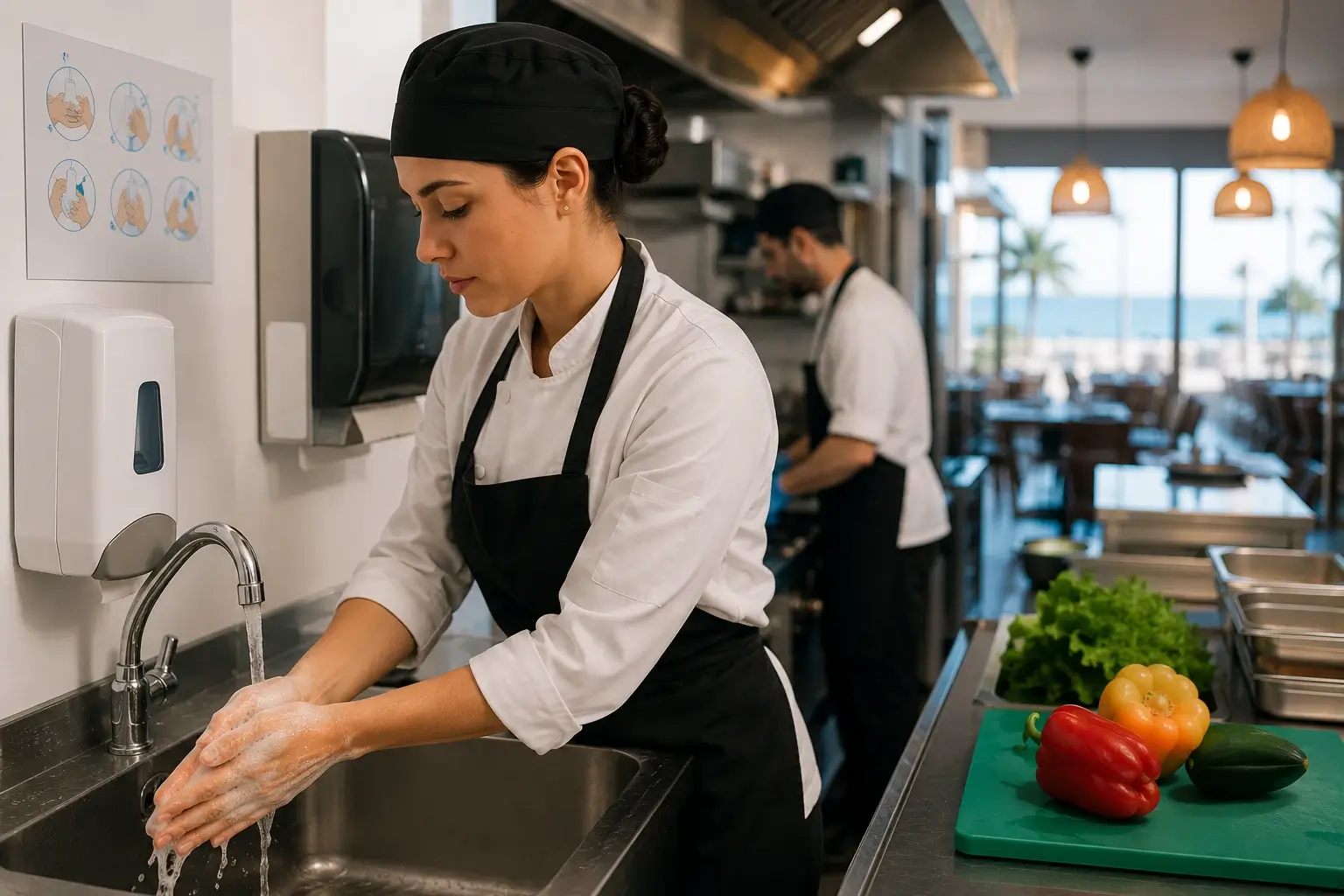
The Human Hand: The Main Vehicle of Contamination in Algarve Kitchens
It’s a technical fact with a direct impact on every restaurant in Faro, Albufeira and Loulé: the hands of food handlers are the main vehicle for transferring pathogenic microorganisms to food — including Staphylococcus aureus, Salmonella, Listeria and E. coli.
In a tourist destination like the Algarve, where the same restaurants serve customers from dozens of countries whose immune systems are not adapted to the local flora, the consequences of food poisoning caused by poor food handler hygiene can be devastating — for customers, for the establishment’s reputation and for the financial health of the business.
The personal hygiene of food handlers is therefore one of the areas that receives the most attention in ASAE inspections of HORECA establishments in the Algarve.
Gel Nails in Restaurants in Faro, Albufeira and Loulé: Are They Banned?
This is one of the questions that most often reaches Algarve restaurant owners — especially in the context of young, international teams working in the Algarve restaurant sector during peak season.
There is no explicit legal ban on gel nails or nail polish for food handlers. But the situation isn’t that simple.
The law establishes that nails should ideally be short, clean and free of polish — because polish (including gel) can hide dirt and make it harder to properly assess the actual hygiene condition of the hand.
What the law allows: If a food handler has gel nails, they can work provided they wear gloves throughout all food handling.
Best practice in Algarve restaurants: In establishments with high hygiene standards — especially fine dining restaurants in Vilamoura (Loulé) or Vale do Lobo — the most common policy is to ban nail polish and nail extensions for anyone who handles food directly.
Cuts, Wounds and Burns: When Working Is Not Allowed
This point is clear in the law and especially relevant in Algarve kitchens in summer, where the intense pace of work raises the risk of accidents:
Gloves must be worn whenever a food handler has grazes, burns or cuts on their hands. Injuries must be covered with brightly coloured waterproof dressings — so they are visible if they fall into food during preparation.
A key distinction:
| Situation | What you can do |
|---|---|
| Clean cut, not infected | Work with a waterproof dressing and gloves |
| Healing burn | Work with a waterproof dressing and gloves |
| Infected wound with pus | Cannot handle food |
| Diarrhoea or vomiting | Cannot handle food |
| Active skin infection | Cannot handle food |
| Jaundice | Cannot handle food |
For restaurants in Albufeira, Loulé and Faro that hire dozens of seasonal workers in summer, it’s essential to have a clear symptom-reporting protocol — workers must know they are obliged to inform management of any condition that could compromise food safety, without fear of reprisals.
Food Handler Training: Mandatory for Seasonal Staff Too
Yes — including seasonal workers. This is an area where many restaurants in Albufeira, Loulé and Faro make serious mistakes during peak season.
The law requires that food handlers receive adequate training in food hygiene and safety, proportionate to the type of work they carry out. This training must be documented with certificates and attendance records.
For seasonal workers who start production in an Albufeira restaurant in June with no documented prior training, the risk is twofold: a food safety risk (an untrained worker is more likely to make hygiene mistakes) and a legal risk (the absence of training documentation is an offence checked by ASAE).
Practical solution for restaurants in the Algarve: Include a food hygiene training session in the onboarding process for all new workers, permanent or seasonal, with a signed attendance record. The training can be short — a few hours — but it has to exist and be documented.
For handlers of meat and charcuterie products in Faro, Albufeira or Loulé, Portuguese law is more specific: it requires training delivered by bodies recognised by the Director-General for Food and Veterinary Affairs.
The Correct Hand-Washing Protocol
Hand washing is the simplest and most effective preventive measure — and one of the most frequently done badly in Algarve kitchens under service pressure:
- Wet the hands with warm water
- Apply liquid soap (never a bar — it accumulates microorganisms)
- Scrub vigorously for at least 20 seconds:
- Palms and backs of the hands
- Between the fingers
- Under the nails
- Wrists
- Rinse thoroughly
- Dry with a disposable paper towel — never a shared cloth towel
Mandatory hand-washing moments in any restaurant in Faro, Albufeira or Loulé:
- Before starting work
- After using the toilet
- After coughing, sneezing or blowing your nose
- After handling raw food (meat, fish, eggs)
- After touching rubbish or cleaning products
- After touching your face, hair or mobile phone
- After any interruption to production activity
Clothing and Protective Equipment in Algarve Restaurants
The law does not define the required clothing precisely, but it requires it to be appropriate, clean and used exclusively in the work area. The good practices checked by ASAE include:
- A clean work uniform used exclusively in the kitchen (you don’t go out onto the street in your kitchen uniform)
- A protective apron in higher-risk areas
- A hairnet or hair covering in preparation areas
- Appropriate footwear used exclusively in the kitchen
- No jewellery, watches or piercings on the hands and wrists during handling
In a setting such as the luxury hotels of Vilamoura or Vale do Lobo, where presentation standards are high, the balance between appearance and hygiene has to be managed with care.
Home-Produced Eggs and Recreational Fishing: What Algarve Food Handlers Need to Know
Home-produced eggs in restaurants in Faro, Albufeira and Loulé:
Using fresh eggs (including home-produced ones) is not prohibited in restaurants — nor in already-cooked dishes such as açordas. But operators are responsible for the safety of the final product.
Home-produced eggs may be bought from small local producers, provided they produce a maximum of 350 eggs per week — and only within the municipality or neighbouring municipalities of the production site. A restaurant in Loulé can buy home-produced eggs from a producer in Alte or São Brás de Alportel, for example.
For dishes with raw eggs (mayonnaises, mousses, chocolate salami), the technical recommendation is to use pasteurised eggs — not as a legal requirement, but as good practice that significantly reduces the risk of Salmonella.
Fish from recreational fishing:
It is prohibited to use fish from recreational fishing in restaurants — even if the owner is a fisher and brings the fish straight from the sea.
FAQ: Food Handler Hygiene in Algarve Restaurants
How often should food handler training be carried out in my restaurant in Albufeira?
The law does not set a minimum frequency. Good practice is annual or biennial training, with an update whenever there are changes to procedures or new staff join.
Can I hire a seasonal worker in Faro without food hygiene training?
You can hire them, but the training has to take place before the person starts food handling duties — and it has to be documented.
Can a food handler with a mild stomach ache work in my restaurant in Loulé?
If there are gastrointestinal symptoms — even mild ones — the person should not handle food. The operational pressure of summer in the Algarve does not justify this risk.
Does wearing gloves replace hand washing?
No. Gloves are an additional barrier, not an alternative. Hands must be washed before putting on gloves, and gloves must be changed whenever necessary.
Food Handler Training in the Algarve — Faro, Albufeira and Loulé
Fiscal Control offers food handler training for HORECA establishments in Faro, Albufeira, Loulé and across the Algarve region — in person, tailored to the needs of each establishment and to the reality of the Algarve’s seasonality.
The training covers personal hygiene, food hygiene, HACCP in the Algarve, allergens and all the legal obligations applicable to restaurants in the Algarve.
👉 Find out more about our training →

FiscalControl can secure your establishment today
Request a free, no-obligation quote. Our team will get in touch with you within 24 hours.
Leave a Reply