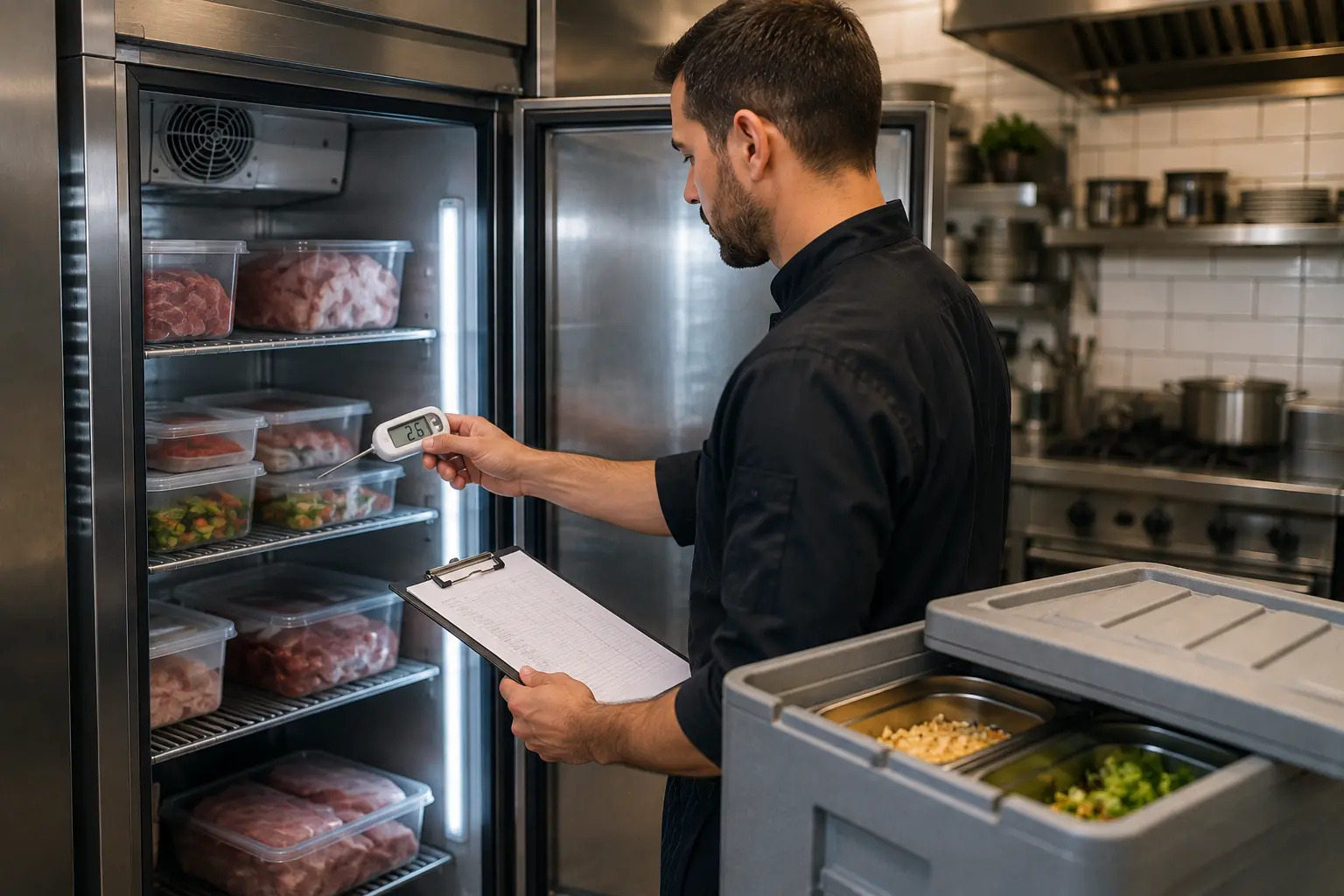
Food storage and transport temperatures? In a restaurant in Albufeira at the height of summer, with an outdoor temperature of 38°C and a kitchen that can reach 45°C near the stoves, temperature control isn’t just a legal obligation — it’s the difference between serving safe food and causing a food poisoning outbreak.
The microbiological “danger zone” — the temperature range between 5°C and 63°C — is precisely where pathogenic microorganisms (Salmonella, Listeria, Staphylococcus aureus, E. coli) multiply fastest. In the Algarve, during the summer months, any lapse in temperature control has accelerated consequences.
Food Storage and Transport Temperatures in Restaurants
Legislation sets specific maximum storage temperatures for different types of products:
Fishery Products and Shellfish
| Product | Maximum temperature |
|---|---|
| Fresh fish, cooked crustaceans and molluscs, refrigerated | Close to 0°C (temperature of melting ice) |
| Frozen fish and shellfish | ≤ -18°C |
| Live fish (holding tanks) | Conditions that do not compromise food safety or viability |
For fish restaurants in Faro, Olhão and Albufeira, keeping fresh fish “close to 0°C” is a legal requirement, not just a quality preference.
Meat — Mandatory Transport Temperatures
| Type of meat | Maximum temperature |
|---|---|
| Deep-frozen meat | ≤ -18°C |
| Frozen meat | ≤ -12°C |
| Fresh meat (except poultry and rabbit) | ≤ +7°C |
| Fresh poultry meat, rabbit, farmed game and meat preparations | ≤ +4°C |
| Fresh minced meat and preparations containing fresh minced meat | ≤ +2°C |
| Fresh offal | ≤ +3°C |
Pastry Products and Eggs
For pastry products containing whipped cream, custards and other perishable ingredients — common in restaurants and pastry shops in Loulé, Albufeira and Faro — refrigeration may be required, depending on the product’s composition.
The operator is responsible for determining the appropriate storage temperature based on the product’s composition. For simple cakes with no perishable filling, refrigeration may not be mandatory. For cakes with whipped cream, egg custards or other sensitive ingredients, refrigeration is essential.
Cooling Cooked Food: Practical Rules
Cooling cooked dishes (rice pudding, custard, sauces, soups) on the kitchen counter is not prohibited by law — but it represents a significant microbiological risk that the operator is required to manage.
Good international practice, accepted in HACCP plans, defines:
- Cooling target: lower the temperature from 63°C to 10°C in under 2 hours
- Recommended method: cold water or ice baths before refrigerating
- In the Algarve in August: with ambient temperatures of 35-40°C, counter cooling is even riskier than in other regions — the time spent in the danger zone is far longer
Records of cooling processes must be included in the establishment’s HACCP plan.
Food Transport: Temperature and Documentation Requirements
All foodstuffs, when transported, must be accompanied by a Accompanying Document — which may be an invoice, transport note or delivery note — ensuring traceability.
Vehicles used to transport foodstuffs must:
- Be capable of keeping food at the legally required temperatures
- Allow those temperatures to be controlled and monitored
- Be kept clean and in good hygienic condition
For restaurants in Albufeira and Faro receiving fresh fish deliveries directly from the fish auction in Portimão or Olhão, checking temperatures on receipt and recording them is a requirement of the HACCP plan.
Freezing in Algarve Restaurants: Mandatory Best Practices
Freezing food in restaurants is permitted — and in the Algarve it’s an essential tool for managing seasonality, especially during the quieter months.
But there are rules:
- Freezing equipment must be suitable and capable of rapid freezing — a domestic fridge-freezer is not adequate for freezing large volumes of cooked food
- Frozen products must be labelled with product identification and freezing date
- Traceability must be ensured
- Packaging must minimise dehydration (freezer burn)
Temperature Records: An Obligation, Not an Option
Restaurants in Faro, Albufeira and Loulé are required to keep temperature control records as part of their HACCP system. This means:
- Daily logging of refrigerator and freezer temperatures
- Logging on receipt of raw materials (especially fresh fish and meat)
- Logging of cooling processes for cooked food
- Logging of hot-holding temperatures (buffets, bain-maries) — minimum 63°C
The absence of these records is one of the most frequently identified infractions by ASAE during restaurant inspections in the Algarve — even when temperatures are actually being controlled.
FAQ: Temperatures in Algarve Restaurants
What temperature should I keep fresh fish at in my restaurant in Faro?
As close to 0°C as possible — the temperature of melting ice. In practice, in boxes with ice or in refrigerated chambers set between -1°C and +2°C.
Can I use a domestic fridge to store meat in my restaurant in Albufeira?
You can, provided the end result guarantees that meat is kept at the legally required temperatures (≤ +4°C for poultry and ≤ +7°C for other meats). In practice, domestic fridges struggle to maintain these temperatures in hot kitchens — industrial equipment is more reliable.
My restaurant in Loulé serves a lunch buffet. What temperature do I need to keep hot dishes at?
Hot-held food must be kept at a minimum temperature of 63°C at every point of the product. Below this temperature, it enters the microbiological danger zone.
How often should I log refrigerator temperatures?
At least once a day, at the start of the working period. During periods of extreme heat in the Algarve, logging twice a day is recommended.
Temperature Control in the Algarve with Fiscal Control
Fiscal Control supports restaurants in Faro, Albufeira and Loulé in implementing temperature control systems integrated into the HACCP plan — including setting logging frequencies, equipment calibration and staff training.
👉 Request an assessment of your HACCP system →
Regulamento (CE) n.º 852/2004; Regulamento (CE) n.º 853/2004; Regulamento (CE) n.º 178/2002.
Technical sources: DGAV — À Mesa: 100 Mitos; ASAE — Mitos e Verdades em Segurança Alimentar.